
AI is redefining digital finance. Explore our curated list of the top AI Crypto coins to watch this month. Expert analysis and real-time data.
The Crypto market continues to shift, and AI tokens are creating new possibilities beyond the hype around traditional memecoins. While many investors chase the “Best Memecoins” for quick gains, AI-powered cryptocurrencies offer something different: projects built on machine learning, neural networks, and autonomous agents that could reshape how blockchain technology works. This article breaks down the top AI Crypto coins and projects worth watching right now, giving you clear information about which platforms are solving real problems and which ones deserve your attention.
Once you understand which AI Crypto projects show genuine promise, the next step is actually getting involved. That's where Bullpen comes in, offering a straightforward way to buy Crypto without the usual headaches of complicated exchanges or confusing verification processes. Whether you're adding AI tokens to diversify your portfolio or exploring new blockchain projects powered by artificial intelligence, having a reliable platform is the difference between staying on the sidelines and acting on opportunities as they emerge.
Summary
AI Crypto tokens often trade on narrative momentum rather than actual utility. Messari's 2025 Crypto Theses report found that only 12% of AI-related Crypto projects had measurable on-chain activity beyond token transfers, indicating that most valuations reflect future expectations rather than current usage. This gap between speculation and substance creates significant timing risk: you might be right about a project's long-term potential, yet still lose money if the market reprices expectations downward before adoption materializes.
The “AI Crypto” category bundles fundamentally different business models under one misleading label. Some tokens represent access to decentralized GPU networks where developers rent processing power, while others govern data indexing protocols or provide infrastructure for autonomous agents. Comparing a compute marketplace to an agent platform is like comparing cloud hosting to an operating system.
Ownership concentration among early investors creates hidden volatility that surface-level research misses. When large holders reduce their positions, price declines can be abrupt and severe, especially in tokens with thin order books. Blockchain analytics consistently show that smaller altcoins with concentrated ownership structures experience greater volatility than widely distributed assets.
AI-related Crypto scams surged 300% in 2024, according to TRM Labs' Crypto Crime Report, reflecting how quickly bad actors exploit narrative-driven hype cycles. When everyone's chasing the next breakout AI token, distinguishing between projects solving real problems and those designed purely to extract value becomes harder.
Liquidity fragmentation across exchanges creates inconsistent pricing and dangerous slippage during stress events. A token might trade with deep order books on one major platform but have thin liquidity elsewhere. CoinGecko's Q1 2025 report found that over 60% of Crypto traders cite delayed execution as their primary barrier to capturing opportunities, particularly in high-volatility sectors like AI tokens, where narrative momentum can shift within hours.
Bullpen addresses this by consolidating Bitcoin, Solana tokens, Hyperliquid perpetuals, and Polymarket prediction markets into a single interface, where performance data, social proof, and real-time momentum signals surface automatically rather than requiring manual research across scattered platforms.
Table of Contents
Why Top AI Crypto is One of the Most Confusing Categories

The “AI Crypto” label doesn't describe a technology. It describes a marketing position. When you see a project tagged as an AI token, you're not learning what it does or how value flows through its system. You're learning that it wants to ride a narrative wave. The category bundles together:
Compute networks
Data marketplaces
Autonomous agent platforms
General-purpose chains claiming AI readiness
This is all under one banner, implying they're comparable. They're not.
What These Projects Actually Do
Some tokens represent access to decentralized GPU networks where developers rent processing power for model training. Others govern data indexing protocols that feed information into machine learning pipelines. A third group focuses on building infrastructure for autonomous agents that can execute transactions without human intervention.
These are fundamentally different value propositions with:
Distinct revenue models
Adoption curves
Competitive moats
Mapping the DeAI Stack
The problem surfaces when you try to evaluate them side by side. Comparing a compute marketplace to an agent platform is like comparing a cloud hosting service to an operating system. Both matter in the tech stack, but success metrics, adoption timelines, and competitive dynamics operate on entirely different axes. One might generate revenue from usage fees for each computing hour sold. The other might capture value through transaction volume as agents proliferate across applications.
The Lifecycle of a Crypto Narrative
Yet during narrative-driven rallies, capital treats them as interchangeable. When AI dominates headlines, money flows into anything labeled as such.
Prices move in lockstep regardless of whether:
A project has live users
Measurable revenue
Even a functioning product beyond a testnet
I've watched tokens double in a week purely because they announced an AI partnership, only to retrace just as fast when the broader theme cooled. The correlation says nothing about the technology. It reflects how quickly attention shifts in markets where most participants trade themes rather than fundamentals.
Why Technical Depth Creates Friction
Understanding whether a project genuinely integrates artificial intelligence requires reading documentation that assumes familiarity with both blockchain architecture and machine learning concepts.
Beyond the Commits: Auditing AI Crypto Health
Most traders don't have time to parse white papers on federated learning protocols or zero-knowledge proofs for private model inference. Marketing materials emphasize ambitious roadmaps over current adoption, making it difficult to distinguish between projects that solve real problems today and those positioned for hypothetical future demand. Developer activity offers clues, but even that requires context. A GitHub repository with frequent commits might indicate genuine progress or just routine maintenance. Without clear criteria, surface-level metrics mislead more than they inform, e.g.:
Integration tests
Third-party usage
API call volume
Future-Proofing via Modular Design
The pace of innovation in both industries compounds the challenge. Artificial intelligence research evolves in months, not years. A project built around today's cutting-edge model architecture might become less relevant if the next generation of AI systems requires different infrastructure. Crypto markets reprice narratives just as quickly. What appears to be a structural advantage in January can become a competitive liability by June if priorities shift or better solutions emerge.
How Fragmentation Hides Real Differences
The term “AI coin” functions as a thematic signal, not a technical classification. It tells you a project operates somewhere in the intersection of blockchain and artificial intelligence, but not:
Where
Why
How effectively
Without understanding the specific role a network plays, comparing market caps or price performance becomes meaningless:
Compute provider
Data layer
Application platform
Agent ecosystem
Decoding AI Crypto Revenue Models
This fragmentation makes it harder to identify credible opportunities than it should be. Traditional exchanges list these tokens alongside one another, implying equivalence. Price aggregators group them under a single category.
Media coverage often treats “AI Crypto” as:
A monolithic sector
Discussing momentum
Sentiment without distinguishing between projects that generate revenue and those still building toward product-market fit
Tools for Data-Driven Diligence
Traders accustomed to moving fast find themselves stuck in research loops, trying to separate signal from noise across dozens of projects with overlapping marketing language but divergent business models. The friction isn't just inconvenient. It creates an information asymmetry where those with time to dig deep gain an edge, while everyone else trades on headlines and hopes the narrative holds.
Aggregated Market Intelligence and Performance Auditing
Platforms like Bullpen reduce research friction by surfacing performance data and social proof in a single interface. Instead of jumping between block explorers, documentation sites, and price charts, you see:
Which tokens are moving
Who's trading them
What public track records look like
When the difference between catching momentum early and chasing it late comes down to how quickly you can evaluate opportunities, unified discovery tools stop being a convenience and start being a competitive requirement.
Where the Confusion Costs You
The real damage happens when confusion leads to paralysis or poor timing. You see a token rally, spend hours trying to understand what it actually does, and by the time you've formed an opinion, the move is over. Or worse, you buy based on surface-level hype without understanding the underlying value driver, then watch the position bleed as narrative attention shifts elsewhere.
The Economic Engine: Auditing DeAI Tokenomics
Markets reward speed, but only when paired with enough context to separate genuine momentum from temporary noise. The “Top AI Crypto” category makes that pairing difficult because the label itself obscures more than it reveals.
Until you move past the theme and examine:
What each network actually does
Who uses it
How value flows through the system, you're trading blind
Related Reading
The Hidden Risks Behind AI Crypto Momentum

Spectacular gains attract capital, but they also attract vulnerabilities that most traders don't anticipate until it's too late. AI Crypto tokens sit at the intersection of two hype-sensitive sectors, which means their price movements often reflect narrative momentum more than measurable adoption. When attention shifts, when macro conditions tighten, or when concentrated holders decide to exit, the same tokens that doubled in a week can retrace just as violently. The risk isn't just volatility. The factors driving instability are often invisible until they've already triggered a cascade.
When Attention Becomes the Primary Driver
Rapid sentiment rotation creates a structural fragility that most participants underestimate. Capital floods into AI tokens when artificial intelligence dominates headlines, then exits just as quickly when the next narrative takes over. This pattern isn't random. It's predictable in aggregate, even if timing individual rotations remains impossible. I've seen projects with working products lose 40% of their value in days when the macro focus shifted to regulatory developments or a competing-sector narrative. The technology didn't change. The attention did.
Identifying Narrative Exhaustion and Liquidity Traps
What makes this particularly dangerous is that price appreciation during hype cycles creates a false sense of durability. When a token climbs steadily for weeks, new buyers assume growth reflects adoption or fundamental strength. They don't realize they're trading a narrative that could evaporate the moment media coverage pivots elsewhere. By the time sentiment cools, liquidity thins, and exit prices compress faster than most can react.
Concentration Risk and the Illusion Of Decentralization
Many AI tokens carry significant ownership concentration among early investors, foundations, or a small number of large wallets. When these holders sell, price declines can be abrupt and severe. Blockchain analytics consistently show that smaller altcoins with concentrated ownership structures experience higher volatility than more widely distributed assets. A single large holder deciding to reduce their position can trigger that cascades through thin order books:
Stop losses
Liquidations
Panic selling
Auditing Token Distribution
The challenge is that ownership concentration isn't always transparent. Some projects clearly disclose token allocations, but others obscure distribution through vesting schedules, multiple wallets, or opaque foundation holdings. Without knowing how much supply could enter the market at any given moment, traders operate with an incomplete risk assessment. The token might appear stable based on recent price action, but that stability can vanish the moment a major holder moves.
Liquidity Fragmentation Across Exchanges
A token might trade with deep order books on one major platform but have thin liquidity elsewhere, resulting in inconsistent pricing and higher slippage. This fragmentation becomes especially problematic during stress events when traders need to exit quickly. Liquidity can deteriorate rapidly across Crypto markets during periods of elevated volatility, amplifying price swings as participants struggle to execute large orders without moving the market significantly.
Mapping Liquidity and Realized Slippage
I've seen traders assume they could exit a position at the price displayed on their primary exchange, only to discover that moving any meaningful size required accepting prices 5% to 10% worse. In fast-moving markets, that slippage compounds losses beyond what stop-loss orders were designed to prevent. The displayed price becomes less relevant than the actual depth available when you need it most.
The Disconnect Between Expectations and Usage
AI tokens often surge on the belief that a project will become critical infrastructure for future systems, not because it's already generating substantial demand.
Prices move:
On roadmap promises
Partnership announcements
Technical milestones that sound impressive
Don't yet translate into revenue or user adoption. When enthusiasm cools or timelines stretch, valuations can compress long before fundamentals change.
Maturity Phases of DeAI
This creates a timing problem that's difficult to navigate. You might be right about a project's long-term potential, but still lose money if the market reprices expectations downward before adoption materializes. The gap between “this could be important eventually” and “this is generating measurable value today” can persist for months or years, during which sentiment-driven volatility dominates price action.
Spotting Synthetic Hype
According to TRM Labs' 2025 Crypto Crime Report, AI-related Crypto scams increased by 300% in 2024, reflecting how quickly bad actors exploit narrative-driven hype cycles. The surge in fraudulent projects makes it even harder to distinguish legitimate infrastructure from opportunistic cash grabs when everyone's marketing sounds similar.
How Macro Cycles Override Individual Merit
Even technically robust projects tend to fall during risk-off periods. The 2022 collapse demonstrated how quickly sentiment shocks cascade across the entire ecosystem, dragging down virtually all altcoins regardless of sector or fundamentals.
When macroeconomic conditions tighten:
Liquidity drains from risk assets
Major exchange or protocol fails
Correlations spike
Individual project quality becomes temporarily irrelevant
Separating Market Noise From Project Health
This means AI tokens carry not only sector-specific risk but also broad Crypto-market exposure. You might invest based on a project's technical merits, team quality, or adoption trajectory, only to see your position decline by 50% as Bitcoin fell 20% and altcoins amplified the move. The project didn't fail. The entire risk environment shifted, and smaller tokens absorbed disproportionate selling pressure.
Technical Red Flags in AI Tokens
Most traders underestimate how quickly fraud tactics evolve and how easily narrative-driven sectors are targeted by sophisticated scams. When everyone's chasing the next breakout AI token, distinguishing between projects solving real problems and those designed purely to extract value becomes harder. Surface-level due diligence (checking for audits, reading white papers, verifying team credentials) helps, but it doesn't eliminate risk when the entire category moves faster than verification processes can keep pace.
Why Unified Visibility Matters More Than You Think
The fragmentation across exchanges, data sources, and community channels creates information asymmetry where those who can aggregate signals fastest gain an edge. When the difference between catching momentum early and chasing it late comes down to how quickly you can evaluate opportunities, platforms like Bullpen stop being a convenience and start being a competitive requirement. Instead of jumping between block explorers, documentation sites, and price charts, you see which tokens are moving, who's trading them, and what public track records look like in one interface. Speed paired with context separates genuine momentum from temporary noise.
Quantifying Hype vs. Utility
For traders and investors, the key insight is that AI Crypto performance often reflects attention as much as adoption. Participants mistake short-term hype for a durable opportunity, without accounting for:
How quickly sentiment can change
How concentrated ownership amplifies volatility
How liquidity constraints magnify exits
Momentum can vanish just as fast as it appeared, and the factors that trigger reversals often operate invisibly until they've already reshaped the market.
The Myth: All AI Coins Are Basically the Same

These projects don't just have different marketing. They operate in fundamentally different parts of:
The technology stack
Capture value through unrelated mechanisms
Respond to entirely separate demand signals.
Grouping them together because they all mention artificial intelligence is like treating Amazon Web Services, Adobe Photoshop, and Uber as equivalent investments because they all use cloud computing. The infrastructure layer, the application layer, and the service layer might all depend on similar underlying technology, but success in one says almost nothing about prospects in another.
Infrastructure Versus Application Logic
Some networks sell raw computational resources. Developers rent GPU clusters to train models or run inference at scale. Revenue flows directly from usage. When demand for processing power increases, these networks capture value immediately through higher utilization rates or pricing. Their competition isn't other Crypto projects. It's centralized cloud providers offering similar compute at potentially lower costs with better reliability guarantees.
The AI Data Supply Chain: Why Indexing is the New Gold
Other tokens govern data indexing protocols. They organize blockchain information so applications can query it efficiently. Value accrues as more applications integrate the protocol and query volume rises. A spike in GPU demand doesn't help them at all. What matters is whether developers building AI applications choose their indexing layer over alternatives, and whether those applications attract enough users to generate meaningful query traffic.
Evaluating On-Chain Autonomy
Then you have platforms designed to host autonomous agents. These systems provide the environment where:
Software entities can hold assets
Execute transactions
Interact with other protocols without human intervention
Success depends on whether developers build agents people actually want to use, whether those agents generate enough transaction volume to justify network fees, and whether the platform can scale without prohibitive costs. Demand and data indexing adoption might be surging, but if no one is building useful agents, the platform stagnates.
Why Correlation Misleads During Hype Cycles
When artificial intelligence dominates the news cycle, capital floods into anything labeled as such. A compute network announces a partnership with a major AI lab, and suddenly, every token tagged "AI Crypto" rallies 20% regardless of whether the news affects them. Traders see momentum, assume the entire category is moving together, and buy based on that correlation. For weeks, maybe months, this works. Prices track each other closely enough that distinguishing between projects feels unnecessary.
Fundamental Validation: Identifying the Utility Floor
Then sentiment shifts.
Maybe:
A regulatory announcement spooks the market
Macroeconomic conditions tighten
Simply, attention shifts to a different narrative
The entire group sells off in tandem. During the decline, correlation remains high. But once the dust settles and prices stabilize, something changes. Projects with real-world usage, measurable revenue, or strong developer ecosystems begin to recover faster. Those relying solely on narrative momentum remain depressed longer, sometimes never regaining prior highs.
Fundamental Resilience vs. Attention-Driven Volatility.
I've watched this pattern repeat across multiple cycles. The tokens that looked identical during the rally diverge sharply during the recovery. One compute network might recover within weeks because enterprise clients continued to use the service throughout the downturn. An agent platform with no live applications remains down 70% six months later because nothing fundamental changed to justify the earlier valuation. The correlation was never about shared fundamentals. It reflected how quickly attention-driven capital moves when everyone's trading the same theme.
Different Growth Drivers, Different Timelines
A surge in corporate AI adoption might drive immediate demand for decentralized compute if enterprises seek alternatives to centralized cloud providers. But that same trend might take years to benefit agent platforms, which first need developers to build useful agents, then need those agents to find product-market fit, and only then start generating meaningful transaction volume. The compute network captures value today. The agent platform captures a hypothesis about tomorrow.
Scalability, Cost-Efficiency, and Decentralized Verifiability
Data protocols face yet another timeline. Their value proposition depends on applications needing decentralized data access at scale. If most AI applications continue to use centralized databases because they're faster and cheaper, adoption will stall regardless of how sophisticated the protocol becomes. The technology might be sound, the team might be strong, but if developers don't face a problem that decentralized indexing solves better than existing solutions, growth never materializes.
Distinguishing Between Speculative ‘Narrative’ and Functional ‘On-Chain’ AI
According to Messari's 2025 Crypto Theses report, only 12% of AI-related Crypto projects had measurable on-chain activity beyond token transfers, suggesting most tokens trade on speculation rather than utility. That gap between price action and actual usage creates risk that's easy to miss when everything's moving together. You might buy a token assuming it benefits from broad AI growth, not realizing its specific value driver hasn't yet been activated and may not for years.
When Category Thinking Costs You
Treating AI Crypto as a single sector leads to portfolio decisions that don't align with your thesis. You might believe that decentralized compute will capture market share from AWS and Google Cloud, a conviction that should lead you to networks that sell GPU time. But if you buy a basket of “AI tokens” because the category is hot, you're also betting on data indexing adoption, agent platform success, and smart-contract ecosystem growth, even though those outcomes are independent of your original thesis.
Avoiding Thesis Dilution in Crypto Portfolios
When one part of the stack succeeds while others stagnate, your returns get diluted by exposure to projects facing entirely different challenges. Worse, you might exit everything during a downturn because the category sold off, missing the recovery in the specific niche where your thesis was actually playing out correctly.
Unifying Fragmented Data for Fundamental Valuation
The fragmentation across exchanges, analytics platforms, and community channels makes this problem harder to navigate. Most tools group these tokens together, displaying them side by side as if they're comparable. You see price charts moving in parallel and assume they're driven by similar forces. Without digging into what each project actually does, how it generates revenue, and what adoption looks like today versus six months ago, you're trading based on incomplete information.
Bridging the Gap Between Sentiment and Adoption
Platforms like Bullpen reduce research friction by surfacing:
Performance data
Social proof
Real-time momentum signals in a single interface
Instead of jumping between block explorers, documentation sites, and community forums to understand whether a token's rally reflects genuine adoption or just narrative momentum, you see which projects are moving, who's trading them, and what their public track records look like. When the difference between catching a structural shift early and chasing temporary hype comes down to how quickly you can evaluate what's actually happening onchain, unified discovery tools become non-negotiable.
What Actually Matters for Each Type
For compute networks, utilization rates and revenue per GPU hour matter far more than token price.
If usage is climbing and enterprises are paying for processing power, the network is working regardless of what speculators think this week.
If utilization is flat while price doubles, you're trading momentum that could reverse the moment attention shifts.
Quantifying Demand-Side Adoption in Decentralized Infrastructure
Data protocols need query volume and application integrations.
How many projects are actually using the indexing layer?
Is that number growing?
Are those applications generating enough queries to justify the protocol's valuation?
Without those metrics, you're guessing. Agent platforms require live agents doing useful work.
How many autonomous entities are active?
What transaction volume are they generating?
Are developers building new agents, or did early experiments fizzle?
If the platform has impressive technology but no one's using it to build anything people want, the thesis hasn't materialized yet.
Distinguishing Network Effects From Incentive-Driven Growth
Smart-contract platforms optimized for AI applications need developer adoption and successful dApps.
Are teams choosing this chain over alternatives?
Are the applications they're building gaining users?
Is transaction volume growing organically, or does it spike only during incentive campaigns?
Each of these questions points to a different success metric, adoption curve, and competitive landscape. Treating them as interchangeable because they all mention artificial intelligence ignores the factors that actually determine whether value accrues over time.
Related Reading
How to Evaluate Top AI Crypto Projects

With dozens of tokens claiming to power the future of artificial intelligence, serious evaluation requires moving:
Beyond branding
Buzzwords
Short-term price action
The most reliable way to assess AI Crypto projects is to focus on real-world functionality: specifically, the network's role in the emerging AI stack and whether that role is likely to generate sustained demand.
Infrastructure Persistence vs. Application Volatility
A useful starting point is determining whether a project provides essential infrastructure or optional services. Infrastructure projects supply capabilities that other systems depend on, such as:
Compute power
Data access
Networking
Execution layers
These functions resemble utilities: if adoption grows, usage tends to grow with it. By contrast, optional applications may struggle if users can easily switch to alternatives or if demand fluctuates with market sentiment.
Whether AI is Core or Cosmetic
Some projects are fundamentally built around machine learning, autonomous agents, or data exchange for model training. Others are general-purpose blockchains or platforms that later incorporated AI branding. The deeper AI is woven into the architecture, the more likely the project's success is tied to genuine technological adoption rather than narrative momentum.
Tracking Technical Health as a Valuation Anchor
Developer activity provides another critical signal. Active ecosystems, measured through code contributions, new applications, and integration work, indicate that builders see long-term potential. In the broader blockchain industry, research from Electric Capital has shown that sustained developer engagement is one of the strongest predictors of network durability, as it drives innovation and user-facing products over time. Token economics also matter. A project's token should ideally capture value from network usage, not just from speculative trading. For example, tokens used to pay for compute, storage, or transaction fees may benefit directly as demand increases. If a token has little functional role beyond governance or trading, price appreciation may depend more on market enthusiasm than on real adoption.
Scalability Under Real Conditions
AI workloads are resource-intensive, requiring significant computing power, data throughput, and reliability. Projects must demonstrate that they can handle increasing demand without performance degradation or prohibitive costs. Networks that cannot scale effectively may struggle even if their underlying concept is strong.
Evaluating Resilience Beyond the Testnet ‘Sandbox’
Many professionals experience frustration when projects present impressive technical specifications that fail under real-world use. Testnet performance rarely translates directly to mainnet behavior, especially when transaction volume spikes or when multiple applications compete for the same resources. The gap between theoretical capacity and operational reality becomes the bottleneck that determines whether developers continue to build or migrate elsewhere.
Bridging the Compute and Data Provenance Gap
Consider whether the project addresses a fundamental bottleneck in the AI ecosystem. Capabilities such as distributed computing, secure data sharing, automation, and system coordination are foundational. Solutions targeting these areas may have more durable relevance than niche applications that depend on specific use cases or trends.
How Fragmentation Obscures Real Performance
The challenge is that evaluating these factors requires aggregating information from block explorers, GitHub repositories, documentation sites, community channels, and price feeds scattered across different platforms. Most traders don't have time to compile this data manually, especially when opportunities move fast and sentiment shifts quickly.
Bridging the Gap Between Social Sentiment and On-Chain Adoption
Platforms like Bullpen reduce research friction by surfacing performance data, social proof, and real-time momentum signals in a single interface. Instead of jumping between multiple sources to understand whether a token's rally reflects genuine adoption or just narrative momentum:
You see which projects are moving
Who's trading them
What their public track records look like
When the difference between catching a structural shift early and chasing temporary hype comes down to how quickly you can evaluate what's actually happening onchain, unified discovery tools become non-negotiable.
Distinguishing Usage From Speculation
Taken together, these criteria shift evaluation from speculation to substance. Rather than asking which token is trending, the more meaningful question is which networks enable capabilities that others cannot easily replicate or ignore. Projects that underpin core functions (compute, networking, data access, or automated coordination) may benefit as both AI and decentralized technologies expand.
Valuing Crypto-AI Through Enterprise Adoption and Settlement Rails
According to the State of Crypto 2025 Report from a16z Crypto, despite significant capital inflows into AI-related tokens, most projects still lack measurable on-chain activity beyond token transfers, suggesting valuations often reflect future expectations rather than current utility. In a space where hype cycles can obscure fundamentals, grounding decisions in utility, adoption, and infrastructure role provides a clearer lens. The projects most likely to endure are not necessarily those with the loudest marketing, but those that quietly become indispensable to how intelligent systems operate in a decentralized world.
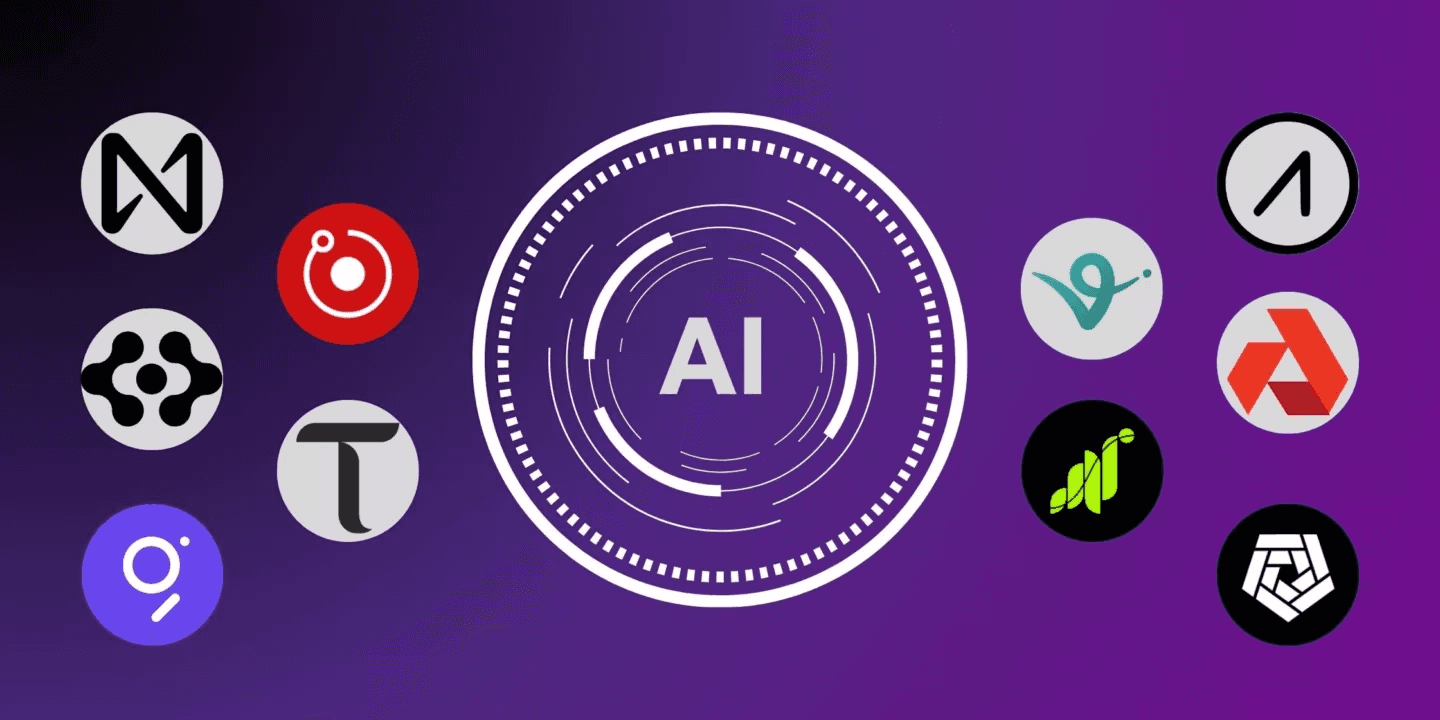
7 Leading AI Crypto Projects to Watch

1. Bittensor (TAO)
Bittensor is designed as a decentralized marketplace for machine intelligence. Instead of relying on a single organization to build powerful AI models, it allows participants to contribute models that collaborate and compete within an open network. Contributors are rewarded with TAO tokens based on the usefulness of their outputs, creating an incentive structure to improve performance.
Comparing Decentralized Protocols vs. Hyperscaler Efficiency
The project's long-term vision is to commoditize intelligence itself, enabling developers and organizations to access machine learning capabilities from a distributed ecosystem rather than centralized providers. Whether this model can scale to compete with established cloud AI services remains an open question, but the architecture addresses a real problem: concentration of AI capabilities among a handful of tech giants.
2. NEAR Protocol (NEAR)
NEAR is a high-performance blockchain platform that has increasingly positioned itself as a foundation for AI-driven applications and autonomous agents. Known for fast transaction speeds and relatively low fees, it aims to support large-scale decentralized apps that require both coordination and computational efficiency. Its architecture is designed for scalability, making it suitable for systems where numerous agents or applications interact simultaneously, a scenario often associated with future AI ecosystems. The platform's sharding mechanism enables parallel transaction processing, potentially supporting the throughput that AI applications may require as they proliferate.
3. Render (RENDER / RNDR)
Render provides decentralized GPU computing power, a resource that modern AI development depends on heavily. By connecting users who need processing capacity with providers who have idle GPUs, the network creates a distributed alternative to centralized cloud services.
Integrating Decentralized Compute With Autonomous Agency
According to risein.com, Fetch.ai (FET) has a market cap of over $2.5 billion, reflecting substantial market confidence in decentralized AI infrastructure. Beyond AI training, Render also supports 3D rendering and digital content production. Because GPUs are a critical bottleneck for advanced machine learning, the project is sometimes described as infrastructure analogous to major hardware providers in traditional technology sectors.
4. Artificial Superintelligence Alliance (FET)
The Artificial Superintelligence Alliance brings together Fetch.ai, SingularityNET, and Ocean Protocol into a unified ecosystem focused on autonomous AI agents, decentralized AI services, and data infrastructure. The goal is to accelerate the development of systems where intelligent software entities can independently:
Operate
Communicate
Transact
By combining agent technology, AI marketplaces, and data-sharing frameworks, the alliance aims to build a full-stack environment for distributed intelligence rather than a single-purpose platform. This consolidation reflects a broader trend: the recognition that fragmented protocols struggle to gain traction when developers need multiple components to work together seamlessly.
5. Internet Computer (ICP)
Internet Computer seeks to extend blockchain capabilities beyond simple transactions by enabling software, including AI-powered applications, to run directly on decentralized infrastructure. Instead of relying on traditional cloud providers, developers can deploy programs that operate entirely within the network. This approach is designed to support high-performance decentralized services with minimal reliance on centralized hosting, enabling applications that combine blockchain trust guarantees with advanced computation. The technical ambition is significant: running complex AI workloads onchain without sacrificing speed or cost-efficiency.
6. The Graph (GRT)
The Graph functions as an indexing and querying layer for blockchain data. It organizes information from decentralized networks so applications can retrieve it efficiently, much like search engines index the web.
Powering Decentralized AI with Subgraphs and GraphRAG
For AI systems that depend on structured datasets, reliable access to clean, queryable information is essential. By making blockchain data easier to use, The Graph supports a wide range of applications, including those that incorporate machine learning. The protocol's role is less visible than compute or agent platforms, but no less critical. Without efficient data retrieval, even the most sophisticated AI models struggle to function in decentralized environments.
7. Akash Network (AKT)
Akash provides a decentralized cloud computing marketplace where users can rent processing power, including GPUs needed for AI training and inference. By aggregating unused capacity from data centers and providers worldwide, it aims to offer lower-cost alternatives to traditional cloud services. As demand for AI compute continues to grow, decentralized marketplaces like Akash position themselves as infrastructure layers that could complement or compete with centralized providers. The economic model is straightforward: if Akash can deliver comparable performance at lower cost, developers have a financial incentive to switch. If it cannot, the technical elegance of decentralization becomes irrelevant.
Decoding Capital Flows and Network Health
Most traders jump between block explorers, documentation sites, and price feeds, trying to piece together which AI tokens are moving and why. That fragmentation creates lag between when momentum starts and when you can act on it. Platforms like Bullpen reduce research friction by surfacing performance data, social proof, and real-time signals in a single interface.
Instead of reconstructing the picture manually, you see:
Which tokens are gaining traction
Who's trading them
What their public track records look like
When the difference between catching a shift early and chasing it late comes down to speed paired with context, unified discovery tools stop being optional.
Mapping Utility From Hardware to Execution
Together, these projects highlight how broad the AI Crypto category truly is. Rather than representing a single trend, they span multiple layers of a potential decentralized AI stack:
Intelligence networks
Compute providers
Data infrastructure
Application platforms
Autonomous systems
Understanding these distinctions is essential for evaluating which projects may benefit most as artificial intelligence and blockchain technologies continue to converge.
How Bullpen Helps You Act on AI Crypto Opportunities Faster
Spotting a promising AI token means nothing if you can't move on it before the window closes. The constraint isn't knowledge anymore. It's the operational lag between recognizing an opportunity and actually holding the position.
Most traders lose momentum in:
The gap between idea and execution
Moving funds between platforms
Navigating fragmented interfaces
Piecing together information from scattered sources while prices move without them
Vertical Integration as a Catalyst for Capital Efficiency
Bullpen collapses that entire sequence into one continuous workflow. Bitcoin, Solana meme coins, Hyperliquid perpetuals, and Polymarket prediction markets all sit in the same interface. You don't switch apps to compare markets or move capital between exchanges. The friction that normally costs you hours or days simply disappears, replaced by direct access to the positions you want when the setup actually matters.
Unified Access Across Markets
Traditional trading setups force you to maintain accounts on multiple platforms, each with separate funding requirements, interface quirks, and withdrawal delays. When an AI token starts moving on Solana while you're logged into an Ethereum-focused exchange, the time required to transfer funds and set up a new position often exceeds the duration of the opportunity itself. Consolidating major Crypto markets into a single app eliminates switching costs entirely. You see Bitcoin moving, Solana tokens gaining traction, or perpetual funding rates shifting, and you act immediately without juggling logins or waiting for cross-platform transfers. The setup that used to require planning now happens in real time.
Performance Transparency Over Social Noise
Social media amplifies voices based on engagement, not results. A trader with 100,000 followers might sound authoritative even if they consistently lose money. Another with 2,000 followers might be up 300% year-to-date, but you'd never find them through algorithmic feeds optimized for controversy rather than competence.
The Transition from Narrative Signaling to On-Chain Verification
Bullpen surfaces traders based on verified profit-and-loss records, not follower counts. The leaderboard shows actual performance, updated continuously as positions open and close. When you follow someone, you're tracking demonstrated skill rather than persuasive marketing. Alerts notify you when top performers enter positions, giving you the option to evaluate their thesis in real time instead of discovering it days later through a thread that's already been shared thousands of times.
Strategies for Eliminating Execution Latency in Volatile Markets
According to CoinGecko's Q1 2025 report, over 60% of Crypto traders cite delayed execution as their primary barrier to capturing short-term opportunities, particularly in high-volatility sectors like AI tokens, where narrative momentum can shift within hours. The gap between recognizing a setup and actually participating in it determines whether you capture the move or chase it after the fact.
Streamlined Funding Eliminates Deployment Lag
Even when you've identified the right opportunity and logged into the right platform, funding delays create another bottleneck. Traditional bank transfers take days. Some exchanges require minimum deposit amounts or charge withdrawal fees that make small position sizing impractical. By the time capital arrives, the setup has either played out or deteriorated.
Leveraging Fiat-on-Ramps for High-Agility Trading
Apple Pay integration, direct bank deposits, and leverage options compress funding from a multi-day process to an immediate one. You decide to act, and the capital is available without waiting periods or navigating wire transfer instructions. For traders working with smaller accounts or testing new strategies across multiple positions, removing funding friction enables you to respond more quickly to changing conditions.
Discovery Built for Speed
Most research workflows involve checking price aggregators, reading community discussions, scanning block explorers for wallet activity, and cross-referencing multiple data sources before forming a conviction. That process works when you have hours or days to evaluate a thesis. It breaks down when opportunities move faster than your research cycle. Seeing which tokens are gaining traction, who's trading them successfully, and what their track records look like in one view compresses discovery from a fragmented hunt into a continuous feed. You're not reconstructing the picture manually every time something moves. The relevant signals surface automatically, letting you focus on evaluation rather than data collection.
Quantifying Execution Latency in 24/7 Markets
Platforms that fragment these functions across multiple tools introduce lag at every transition. Finding a token on a price aggregator, researching it on a separate documentation site, checking liquidity on a block explorer, and finally moving to an exchange to execute means losing minutes or hours at each step. When the difference between entering at the start of a move and entering halfway through determines whether your risk-reward makes sense, those minutes matter more than most traders realize.
Why Integration Changes the Game
The advantage isn't just convenience. It's about maintaining decision quality under time pressure. When you're forced to rush through multiple platforms, you skip steps.
You don't check liquidity depth because it requires opening another tab.
You can't verify wallet concentration because the block explorer takes too long to load.
You don't compare funding rates across exchanges because it would require logging into three different accounts.
Consolidating the workflow enables you to move faster without cutting corners. The information you need to make an informed decision sits alongside the execution interface. You're no longer choosing between speed and thoroughness. You're operating in an environment where both are possible simultaneously.
Buy Crypto Today With Bullpen
If you want to trade AI Crypto opportunities smarter, faster, and without juggling multiple platforms, Bullpen gives you the tools to act when timing matters most. Deposit today to earn a 500-point bonus, and receive a free introductory call when you deposit $1,000 or more.
You're no longer choosing between thorough research and quick execution.
You're operating in an environment where both happen simultaneously, where the gap between recognizing momentum and holding the position collapses into seconds instead of hours.
The tokens moving right now won't wait for you to finish transferring funds between exchanges or piecing together fragmented data. When the setup is right, the window is already closing. Bullpen puts discovery, evaluation, and execution in one place so you can move on conviction instead of losing momentum to operational friction.
Related Reading
Last Updated:
March 23, 2026