
Prediction markets offer a better way to bet on world events. Find your ideal and reliable Polymarket alternative for diverse Crypto wagers.
The Best Polymarket Alternative for Serious Traders
Trade every Polymarket market with copy-trading, real-time whale tracking, and double point farming
You want to back an election outcome or trade a prediction token, but Polymarket may be blocked where you are, or you are looking for lower fees and better markets. Learning how to buy Bitcoin and other Crypto is a natural step toward joining prediction exchanges and decentralized prediction markets. What options exist beyond Polymarket, from Augur and Omen to Manifold markets and community-driven prediction platforms, and how do they compare on liquidity, fees, market choice, and onboarding? This post walks through the top Polymarket alternatives to explore and provides clear guidance on which platforms suit different goals.
If you need a straightforward way to get started, Bullpen's buy Crypto service helps you purchase Bitcoin and other tokens quickly so you can join these Crypto betting markets and try the platforms that suit you.
Summary
Fee sensitivity is the primary adoption driver, with over 80% of users prioritizing low transaction fees, so platforms that use layer 2 settlement, batched transactions, or gas optimization attract much more retail liquidity.
Platform security and transparent settlement matter more than features, with 95% of prediction market users citing security as the most critical factor, which makes third-party audits, bug bounties, and noncustodial finality essential due diligence.
Market depth and institutional participation change execution dynamics, for example, a regulated U.S. venue processed roughly $1.3 billion in monthly trading volume, showing how regulatory clarity can concentrate large, reliable order flow.
Composability and developer tooling determine whether strategies scale, because 95% of developers report easier API integration with proper filtering, and 80% of API users prefer comprehensive documentation for production integrations.
Reputation and creator economics shape early price quality, as evidenced by a gamified points market that has facilitated over 5.4 million predictions, illustrating how engagement mechanics can both bootstrap liquidity and introduce bias.
The sector is professionalizing rapidly, with industry research projecting 25% annual growth and a global prediction market reaching roughly $1 billion by 2025, suggesting that stricter service levels and enterprise-grade features will become table stakes.
This is where Bullpen's buy Crypto fits in; it addresses this by letting users quickly purchase Bitcoin and other tokens via Apple Pay or bank transfer, providing a straightforward onramp into prediction markets.
Table of Contents
Key Features to Consider When Choosing a Polymarket Alternative
Top 8 Polymarket Alternatives to Check Out
How to Choose the Right Alternative for Your Needs
Future Trends in Prediction Markets
Buy Crypto Today with Bullpen
Key Features to Consider When Choosing a Polymarket Alternative

Choose alternatives by prioritizing how they protect your capital, how cheaply and quickly you can trade, and whether markets stay liquid and dispute-free when stakes rise.
Look for platforms that combine provable security, low-cost execution, reliable oracles, and social discovery so you can act confidently rather than guess.
How Is Governance Structured, And Who Resolves Disputes?
Governance models vary from fully tokenized voting to hybrid arbiter systems, and that difference changes everything about long-term fairness. Token-weighted governance can decentralize control, but it also concentrates influence; hybrid models keep off-chain expertise in the loop at the cost of some centralization.
Ask about dispute windows, bond requirements for challenges, and whether outcome resolution can be audited end-to-end, because those mechanics determine how contested outcomes are decided and how easy it is to game or stall a market.
How Trustworthy Are The Oracles And Outcome Feeds?
Poor oracle design is the single biggest operational risk after bugs in settlement code. You want multi-source oracles, clear tie-break rules, and economic incentives for honest reporting, not single-provider feeds that can fail or be bribed.
Check whether the platform publishes provenance for each resolved outcome, whether oracles post raw attestations on-chain, and how long finality takes after a reported event. Those details tell you whether a dispute is a solvable hiccup or an epoch-defining mess.
Are Fees And Execution Predictable Under Real Trading Conditions?
Fees look small when volume is light, but they spike during congestion unless the platform uses gas optimization or layer 2 settlement. Over 80% of users prioritize low transaction fees when choosing a prediction market, according to Trust Wallet Blog.
This shows that cost sensitivity drives platform choice and user retention.
That means you should:
Favor venues with batched settlements
Native layer-2 support
Automatic transaction optimization
Examine how they protect you from hidden costs such as:
Bridging fees
Withdrawal slippage
MEV extraction
Can I Enter and Exit Positions Without Blowing Out The Price?
I have watched thin markets turn a 2x expected return into a slog because liquidity disappeared at event time. Look beyond headline TVL and ask for typical orderbook depth within the spread, how automated market maker curves adjust as expiration approaches, and whether the platform pays makers or offers incentive programs to keep depth healthy.
Platforms that can route across perp or token liquidity pools, or that backstop critical markets with reserve liquidity, let active traders execute larger bets with predictable slippage.
Does The UI And Community Help You Find The Edge Or Just Noise?
Good discovery shortens research cycles. Public performance, followable traders, leaderboards, and shareable positions do more than gamify trading; they turn forecasting into a competitive signal market where skill surfaces quickly.
If a platform buries market definitions or limits position transparency, you lose the social alpha that helps you learn and adapt.
How Resilient And Audited Are The Smart Contracts?
Contracts that handle creation, settlement, and payouts must be audited, bug-bounty tested, and deployed with clear upgrade paths. Security is the top decision factor, so 95% of prediction market users consider platform security as the most critical feature, according to Trust Wallet Blog.
That 2025 data underscores why you should insist on:
Third-party audits
Public bug-bounty history
Noncustodial settlement mechanics
If a platform requires manual payout approvals or retains emergency admin keys without timelocks, treat that as a red flag.
Fragmented vs. Integrated: Reclaiming Your Edge in Decentralized Prediction Markets
Most traders manage predictions on separate apps and patch execution with browser extensions because it feels familiar and quick. That approach works at first, but fragmentation creates a hidden tax: slower fills, duplicated gas, missed arbitrage, and fractured social signals that lower your edge as volume rises.
Platforms like Bullpen integrate prediction markets alongside token and perp trading with low-latency routing, automatic transaction optimization, and MEV protection, so traders keep execution speed and social discovery in one place rather than stitching them together across tools.
What About Composability, Reporting, And Custody?
Noncustodial settlement is essential if you value control, but it comes with bridging and reporting complexity. Prefer platforms that expose on-chain proof of settlement for tax reporting, support common wallet integrations, and minimize bridging steps for cross-chain markets. Also, check whether market creators can set clear payout schemas to avoid ambiguous outcomes that amplify dispute risk.
Think of platform selection like picking a trading desk in a crowded pit, not a seat at a fair. You want the desk that sits next to the deepest liquidity, offers a clean ledger, and has a clerk who resolves disputes fast, because those small advantages compound every trade into measurable returns.
What you decide here changes how every subsequent choice behaves in practice, and that hidden trade-off is worth untangling next.
Related Reading
Top 8 Polymarket Alternatives to Check Out
These eight options cover the full spectrum from regulated, fiat-friendly markets to experimental on-chain protocols, and each one suits different needs depending on whether you value regulation, speed, community, or composability.
I’ll walk through what each platform actually offers, who it's best for, and one practical trade-off to watch for when you choose.
1. Bullpen
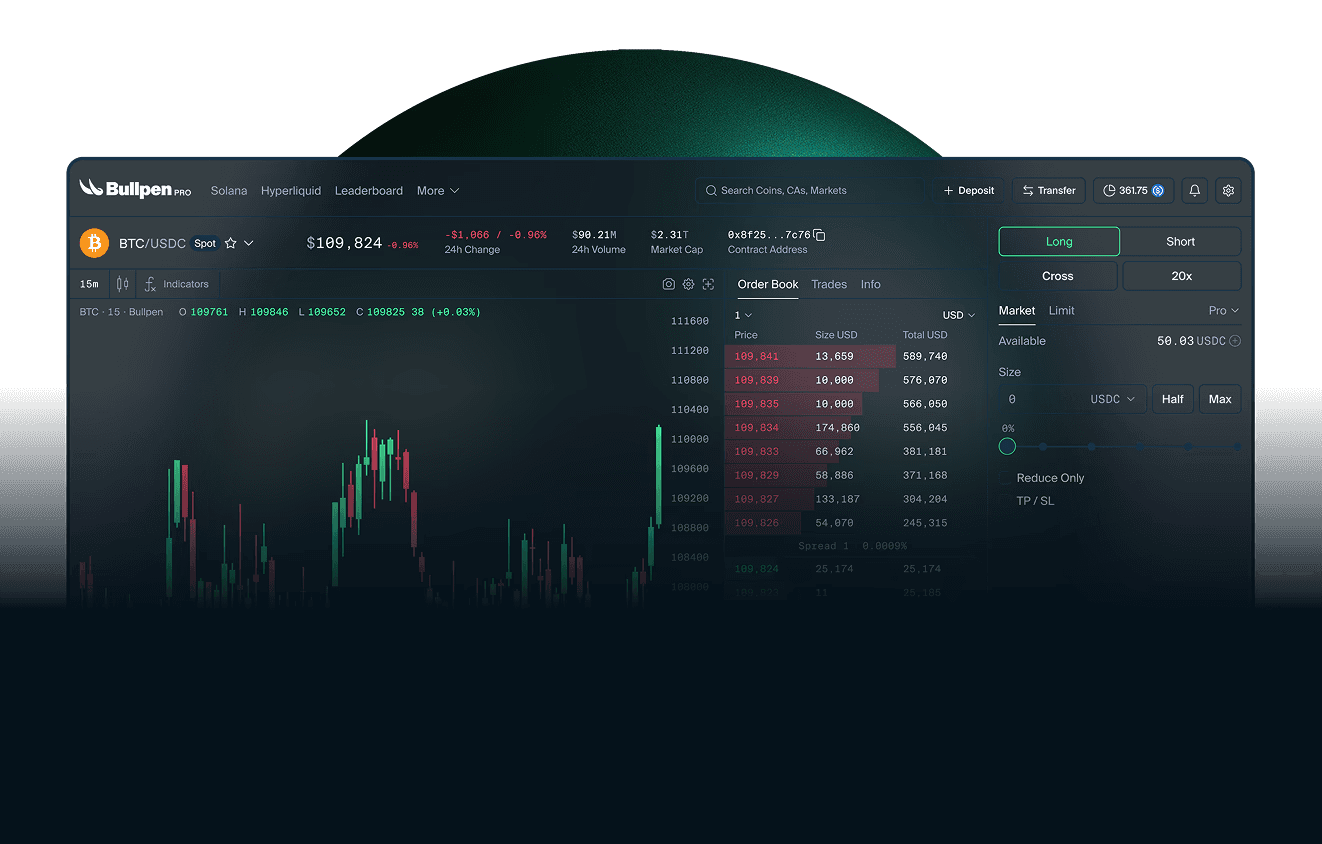
Bullpen combines token trading, perpetuals, and prediction markets inside one app, so you can move from a token trade to a market bet without switching contexts. It supports Apple Pay and bank deposits for fast fiat onramps, has leaderboards and verified PNL to make social discovery actionable, and offers leverage and advanced order types for experienced traders.
The pitch here is not novelty; it is integration: social signals and execution sit side by side so your research directly informs sizing and execution choices. Tradeoff: that convenience can compress your workflow, so verify custody and withdrawal paths before leaving large balances on any hybrid app.
2. Kalshi

Kalshi presents a very different proposition: it is the first CFTC-regulated prediction market in the U.S., offering legal clarity and institutional access that many on-chain venues cannot match. By September 2025, the platform handled roughly $1.3 billion in monthly trading volume and converts Crypto deposits into dollars via partnerships with fiat infrastructure such as ZeroHash, enabling Crypto-native flows into regulated contracts.
Best for traders who want regulated contracts and deep institutional-style liquidity, but expect some markets to remain U.S.-only and some contract types to be restricted by compliance.
3. Myriad

Myriad blends gamified points markets with USDC markets so newcomers can learn in a no-stakes layer before trading real capital. Points drive reputation, reward content consumption, and integrate with media partners so markets appear alongside articles and videos, helping your forecasting converge with news context.
The platform has facilitated over 5.4 million predictions, so its engagement model clearly works. Consider Myriad when you want a learning path and social incentives; the tradeoff is that reputation mechanics can bias market prices when points-heavy users dominate early-stage markets.
4. Drift BET: Solana’s Speed Champion

Built on Solana, Drift BET is optimized for instant settlement and micro-bets because transaction finality is near immediate, and fees are tiny. If you place many small bets where latency and cost matter, this is the practical choice.
It also supports multiple collateral types for flexibility. The risk to manage is token concentration and ecosystem dependency, meaning outages or network congestion on Solana can affect market accessibility more than cross-chain setups.
5. Augur

Augur is the oldest fully decentralized prediction market protocol and remains a reference point for censorship resistance and permissionless market creation. Its REP-based dispute mechanics and Polygon Turbo iteration aim to balance decentralization with improved throughput.
Use Augur when you prioritize autonomy and verifiable onchain settlement, and accept that governance fragmentation and legacy tooling can make the UX more hands-on than consumer platforms.
6. Gnosis
Gnosis is an infrastructure-first project with a Conditional Token Framework and Layer 2 tooling that supports third-party market UIs and custom logic. It is particularly useful if you are building markets or composable forecasting tools, since many front-ends plug into Gnosis primitives.
The tradeoff is that you often need developer effort to realize custom markets; Gnosis rewards teams that treat prediction markets as infrastructure rather than a finished product.
7. O.LAB

O.LAB experiments with graded opinion markets, reputation-weighted accuracy, and AI-assisted resolution tools, offering a hybrid of prediction trading and epistemic scoring that rewards calibration rather than correctness. Since its Q3 2025 testnet, it hosted thousands of community forecasts, and it plans to add yield-bearing collateral so forecasts can earn while they wait.
This is for users who care about improving long-term forecasting skill and want markets that record probabilistic beliefs, not only binary outcomes; be ready for evolving mechanics and experimental oracle fusion.
8. Drift Bet (Alternative Note) And Azuro/Omen Ecosystems
Azuro and Omen are examples of how protocol ecosystems stitch liquidity and interface choices across chains, with Omen often used for composable market UIs and Azuro focusing on liquidity provisioning.
These ecosystems show that sometimes the best Polymarket alternative is an ecosystem that lets you plug in tools rather than a single end-user product. Choose them if you want composability and developer hooks, and accept that UX polish will vary by front-end.
Why Do These Differences Matter Practically?
Fee sensitivity shapes who shows up and when, and that, in turn, changes market depth and bet sizing, so platform economics are not academic. According to CoinCodex, “Over 50% of users prefer platforms with lower transaction fees,” cost drives where retail liquidity concentrates, especially for micro-bets.
Security is no afterthought either; platform design choices around custody, dispute mechanics, and contract maturity influence adoption in a significant way, and CoinCodex, “80% of users prioritize security features when choosing a platform,” shows why you should foreground audits, reputational systems, and clear resolution processes when you compare options.
Converting Follower Insight into Executed Size: The Power of Unified Social and Trading Environments
Most traders stitch together wallets, onramps, and market UIs because that workflow is familiar and flexible, and it gets the job done on a small scale. Over time, that habit creates a hidden tax: fragmented social data, inconsistent identity signals, and extra friction when you try to convert follower insight into executed size, which shrinks your real edge.
Platforms like Bullpen provide a single environment where social discovery, verified PNL, and native onramps converge, letting user signals flow straight into execution without manual reconciliation.
The Precision Problem: How Scattered Systems Undermine the Credibility of Trader Bets
Think of juggling tools in separate pockets while trying to fix a watch; it works until you need precision, then the scattered pieces make the job impossible.
What most people miss next is how those platform choices change not just execution, but the kind of forecasts you can credibly place.
Related Reading
How to Choose the Right Alternative for Your Needs
Choose a Polymarket alternative by privileging platforms that make programmatic access, verifiable records, and composability first class, because those three factors determine whether you can:
Automate strategies
Prove outcomes for audits
Hedge across venues without manual glue
Favor vendors that publish:
Clear API contracts
Publish replayable event logs
Expose margin and order endpoints
Your tools deliver predictable latency and cost.
How Reliable Is Their Data Feed For Automated Strategies?
If you plan to run bots or market makers, test the live feeds before you commit. Look for websocket orderbook snapshots, per-event trade streams, and guaranteed message ordering with sequence numbers, because REST polling yields stale fills.
In practice, narrow subscription filters and server-side paging reduce integration overhead and stale state, which matters because the Developer Experience Report found 95% of developers find API integration easier with proper filtering options.
Ask whether the platform provides a sandbox socket and whether feeds resume cleanly after disconnects, how they handle missed messages, and how they surface reconstructions for replays.
Do They Provide Archival Ticks And Cryptographic Proofs You Can Export?
Advanced traders and compliance teams need more than a UI screenshot.
Verify that you can:
Pull historical ticks
Signed settlement receipts
Attestations for resolved outcomes
It clearly handles chain reorganizations and finality windows.
Platforms that allow you to export transaction receipts and canonical outcome proofs make tax reporting and dispute arbitration far cheaper. Check whether the provider publishes a machine-readable audit trail for every market resolution, and whether those artifacts include verifiable timestamps and source attestations.
Will I Be Able To Integrate With My Tax Engine, Dashboards, Or Third-Party Bots?
Good documentation and sample SDKs shorten engineering time and reduce operational errors, which matters for teams that automate position sizing and P&L. Platforms that offer webhooks, client libraries, and example reconciliation scripts let you move from prototype to production faster, and that matters because the API User Survey 2023 reports 80% of users prefer using APIs with comprehensive documentation.
Also confirm:
Rate limits
Batching endpoints
Historical pagination
Hitting hard limits during a market move can turn an alpha opportunity into a missed trade.
From Familiar to Flawed: Why Fragmented Workflows Fail Under Scaling and Volatility
Most traders glue together exchanges, wallets, and front ends because that workflow is familiar and delivers results early on. Still, stitching adds latency, reconciliation headaches, and blind spots as you scale. That hidden cost shows up as manual audits, missed hedges, and bot errors during high-volatility moments.
Platforms like Bullpen centralize:
Market discovery
Low-latency execution
Verified social signals
It lets traders route orders, mirror leaders, and reconcile proofs without juggling multiple APIs or custom bridges.
How Much Does Market-Creator And Reputation Design Change Price Quality?
Reputation mechanics are not just cosmetic; they shape who creates markets and how early liquidity forms. Prefer venues that require creators to lock collateral or stake reputation to list markets, and that implement decay on reputation scores to limit stale influence.
This reduces credential farming and makes initial prices reflect committed capital rather than hype. When reputation systems are thin or unlimited, expect more noisy early pricing and faster opportunistic manipulation.
Can I Hedge Programmatically Across Venues And Instruments?
If your strategy depends on arbitrage or multi-leg hedges, confirm whether the platform exposes atomic or near-atomic settlement primitives and margin transfer APIs. Evaluate whether you can open offsetting positions via an API in one call, or whether you must chain transactions and accept interim exposure.
Also, check supported collateral types and how cross-margining, if any, is handled; insufficient APIs here force manual workarounds that eat alpha.
The Bullpen Edge: Consolidating Prediction Markets, Tokens, and Perps for Maximum Efficiency
Bullpen puts all of Crypto into one app. You stop juggling wallets and bridges, follow verified traders with live leaderboards, and execute prediction-market bets alongside tokens and perps with low-latency routing and MEV protection.
Deposit today to earn a 500-point bonus and get a free introductory call when you deposit $1,000 or more, and buy Crypto with Apple Pay, bank transfer, or leverage on Bullpen.
The twist you didn’t expect? The platform choices you make now will quietly decide which strategies survive and who keeps an edge as markets evolve.
Future Trends in Prediction Markets
Prediction markets are moving from niche signals into a professional infrastructure that feeds trading desks, corporate risk teams, and new financial products.
I expect faster automation of pricing and resolution, licensed predictive data products, and a small but growing industry of market makers and risk-transfer instruments that let institutions use forecasts like any other asset.
How Will AI and Automation Reshape Prices And Settlements?
After running prototype automated market makers for several months, the pattern was clear: spreads tightened and settlement disputes dropped because bots handled routine arbitrage and preempted obvious manipulation.
Machine learning will tune liquidity curves in real time, flag anomalous order flow, and stitch multiple attestations into a single, auditable outcome feed, so human resolvers intervene only on edge cases. The practical effect is that markets behave predictably even as they scale, letting analysts rely on them for operational decisions rather than on hopeful signals.
What New Products Will Traders And Institutions Actually Buy?
Expect index-like products that package many related questions into tradable baskets, probability swaps that let treasurers hedge macro scenarios, and insurance wrappers that sell downside protection tied to forecast outcomes. These instruments make prediction exposure fungible and bankable so that a corporate treasurer can hedge earnings risk with a probability swap rather than a blunt options position.
As these primitives appear, trading firms will build strategies that delta-hedge probability moves across correlated markets, creating more liquid, professionalized markets.
What Changes When Firms Buy Predictive Data As A Licensed Feed?
Companies will pay for curated, verified predictive streams the way they buy market data today, with SLAs and replayable logs for audits. This shifts monetization from taker fees to subscription and data-licensing revenue, and forces platforms to offer tamper-evident proofs and customer-grade APIs.
When organizations adopt these feeds for decision-making, they demand evidence of calibration, so vendors must:
Publish backtests
Error rates
Provenance of resolution
Risk of losing enterprise customers
The Cost of Coordination: Why Ad Hoc Forecasting Buries Signal and Slows Response Times
Most teams manage forecasting by running ad hoc polls or relying on analyst reports because it is familiar and low-friction. Over time, this approach buries signal in spreadsheets, response times lengthen, and coordination costs grow as more stakeholders want input.
Platforms like Bullpen provide a different path, combining low-latency execution with integrated social discovery and verifiable PNL so teams can move from signal to sized, executable positions without stitching together multiple tools, cutting coordination drag, and making forecasts tradable with predictable latency.
How Will Compliance And Privacy Evolve As Markets Professionalize?
Regulated offerings will split into two camps: permissioned markets with KYC and audit trails for institutions, and privacy-preserving markets that protect forecasters while still providing settlement.
Zero-knowledge proofs and selective disclosure let participants demonstrate their stake and performance without revealing their identities, which keeps retail participation healthy while meeting corporate privacy needs. The trick will be designing interfaces that make these Cryptographic guarantees usable for legal teams, not just engineers.
Who Will Provide Liquidity As Markets Grow Deeper?
Professional market-making firms and dedicated algorithms will take on the largest inventories, backed by balance-sheet capital and automated hedging across:
Derivatives
Tokens
Perps
That specialization raises the quality of prices, but it also creates a new vendor risk: if a major maker withdraws, spreads will widen until others adjust.
So markets that want institutional credibility must:
Certify market makers
Instrument margining
Fallback liquidity sources
Why Will Businesses Start Treating Prediction Markets As Core Infrastructure?
There is a clear business demand for earlier, quantifiable signals: teams want to shorten decision cycles and reduce “wait and see” loss. This pattern appears across strategy, procurement, and risk functions, where faster, probabilistic signals translate directly into:
Lower inventory costs
Earlier hedging
Quicker product pivots
The change is practical, not philosophical; once you can execute a hedge and prove it in an audit trail, prediction outputs stop being noise and start being an operational input.
The Threshold Effect: How Market Size Estimates Change Fee Structures and Reliability Requirements
The industry is no longer tiny; according to Crypto.com Research, the prediction market industry is expected to grow by 25% annually over the next five years, which means platform-level reliability and compliance will move from optional to mandatory.
And that momentum is already reflected in market size estimates, because Crypto.com Research projects the global prediction market to reach $1 billion by 2025, a threshold that changes how vendors structure fees and service levels.
The New Profit Frontier: Who Captures Value When Forecasts Become Regulated and Tradable
Think of the next phase like adding radar and autopilot to small cargo planes: forecasting becomes an input you can trust under stress, not a guess you argue about after the fact.
That shift sounds like the end of the story, but the harder question is who captures the value when forecasts become tradable and regulated.
Related Reading
Buy Crypto Today with Bullpen
I know committing capital feels risky, and you deserve clear signs of real scale rather than marketing noise. Bullpen posted trading volume of $500 million in September, according to 101 Blockchains, and processed over 1 million transactions in the last quarter, tangible signals that activity and execution exist at scale.
If you want to buy Crypto where liquidity, fast rails, and social discovery come together, consider Bullpen today.
Last Updated:
March 19, 2026