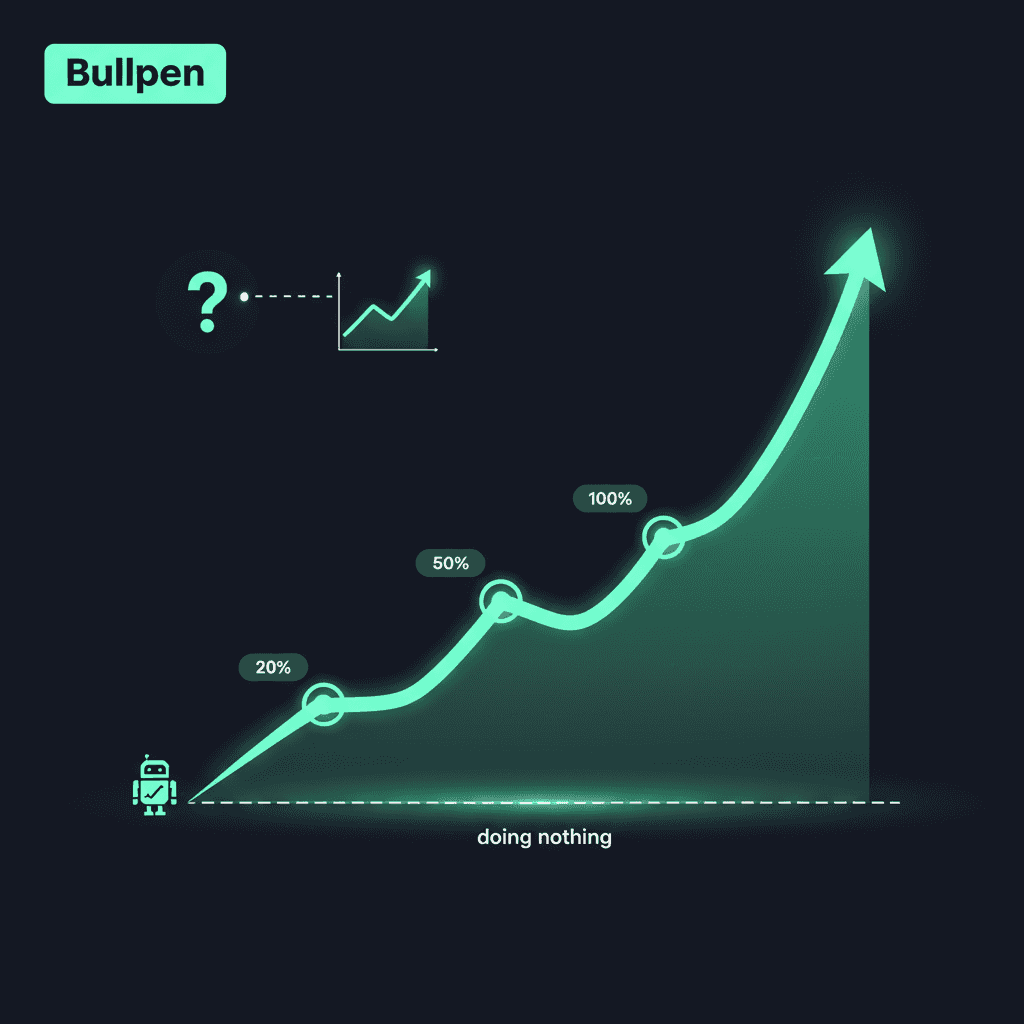
Master market dynamics with tested grid and arbitrage strategies. Success requires active management to ensure crypto trading bots are profitable.
You check your portfolio and ask what makes crypto go up—is it news, liquidity, trader behavior, or a cascade of automated trades? Automated trading can seem like an easy path to profit, but success depends on strategy, backtesting, risk management, fees, execution speed, and market volatility. Can a bot beat your emotions and deliver steady returns? This article will help you determine whether crypto trading bots are profitable and what factors drive their performance.
To help you act on what you learn, Bullpen's buy crypto feature makes it simple to fund trades, test strategies, and monitor bot performance across exchanges with no complex setup.
Summary
Trading bots drive market structure, accounting for over 70% of cryptocurrency trading volume, so execution quality and routing matter as much as the strategy logic.
Automated systems run 24/7 and can increase actionable trading opportunities by about 30%. Still, that boost does not guarantee profits because off-hour spreads, depth, and adversarial behavior change the risk-reward profile.
Vendor claims can be misleading, with some bots advertising up to 50% higher returns than manual trading. Yet such figures require exchange-verified evidence and out-of-sample validation before they are credible.
Operational fragility is the standard failure mode, with research showing that roughly 90% of bots fail to adapt to sudden market changes, resulting in missed cancels, duplicate fills, and state inconsistencies that erode theoretical edges.
Transparency and rigorous controls matter: decision accuracy improved by 20% under transparent conditions; 75% of participants reported increased trust with visibility; and roughly 60% of bot failures are tied to inadequate testing and risk management.
This is where Bullpen's buy crypto fits in: it helps teams fund trades quickly, run paper and canary deployments across exchanges, and access verifiable trade records to monitor bot performance.
Table of Contents
What Is a Crypto Trading Bot?

A crypto trading bot is software that follows predefined rules to place orders automatically, acting as an execution layer that enforces strategy and risk rules without emotion or delay. It does not create an inherent trading edge; what matters is the strategy, the access to liquidity, and the execution plumbing behind it.
How Do Bots Shape Real Market Activity?
The practical effect is not theoretical; it is structural: over 70% of cryptocurrency trading volume is driven by trading bots. This finding shows bots are the primary drivers of on-chain liquidity, meaning any trader’s results depend as much on where and how orders hit the market as on the logic that determines them.
Do Bots Create More Chances to Trade?
When markets never sleep, neither can a program, which reshapes the trading landscape. Crypto trading bots can execute trades 24/7, potentially increasing trading opportunities by 30%. This structural boost in actionable moments does not guarantee profit, so strategy design must account for around-the-clock fluctuations in spreads, depth, and market behavior.
What Common Failure Modes Should Traders Watch For?
The familiar approach is to treat automation as a shortcut to higher returns. That works early, but when you scale volume or run during thin hours, three failure modes emerge:
Poor routing increases slippage
Limited access to deep liquidity leaves large fills exposed
Extractive MEV patterns siphon value
Each of those is a plumbing problem, not a mystery about the algorithm itself.
How Could Infrastructure Change the Outcome for Both Bot and Human Traders?
Most teams manage execution using exchange defaults and simple RPC calls because they are familiar and low-overhead. As order size, frequency, or latency sensitivity rise, that setup leaks value: fills worsen, priority fees are misjudged, and arbitrage hunters profit from predictable behavior. Platforms like Bullpen offer integrations and optimization layers, such as Jupiter Ultra and Hyperliquid; real-time transaction tuning for landing, priority fees, and Jito tips; plus MEV protection. Traders find these capabilities reduce execution losses and enable the same strategy to perform more consistently without surrendering custody.
A Short, Concrete Analogy
Think of a trading bot as a precision engine, one built to accelerate; run it on a potholed backroad, and you wreck performance, give it a race track with tune-ups and pit support, and you realize its design.
Why People Think Trading Bots Should Be Profitable

People think trading bots should be profitable because they promise to scale discipline, speed, and nonstop attention into a neat, repeatable package, and because that promise is easy to sell. Buyers see automation as a technical shortcut from good intent to consistent gains, so marketing, selective disclosure, and illusion of scale do the persuading more than verified outcomes.
Why Do Vendor Claims Sway Traders So Strongly?
This pattern appears across retail and institutional setups: glossy backtests, screenshots of winning days, and promises of outsized returns create a strong cognitive nudge, especially when traders are exhausted from manual mistakes and missing moves. Some advanced trading bots claim to achieve up to 50% higher returns compared to manual trading, a Coincub claim that fuels optimism but needs exchange-verified proof and out-of-sample validation to be credible.
How Does Nonstop Execution Change Perception?
Speed and continuous execution create a tangible sense of opportunity, prompting traders to expect profits. Crypto trading bots can execute trades 24/7, potentially increasing trading opportunities by 30%. While this provides more actionable moments, the raw increase in opportunities does not account for thinner spreads, higher slippage, or adversarial behavior during off-hours.
What Are Traders Missing When They Trust the Promise?
The familiar approach is to equate disciplined execution with an edge. That makes sense early on, but it hides two costs: first, unverified performance claims create false confidence, leading to larger position sizing and faster drawdowns; second, relying on basic exchange plumbing and opaque routing creates execution leakage that eats the theoretical edge. Platforms like Bullpen offer integrations with Jupiter Ultra and Hyperliquid, real-time transaction tuning for landing and priority fees, and MEV protection, enabling teams to validate strategies transparently and reduce execution loss as they scale.
Why is the Emotional Reaction So Strong
This frustration is common: traders feel misled when a bot’s marketing promises precision, but fees, slippage, and unverifiable records obscure the actual profit picture. The sensible response is methodical skepticism, not cynicism, so start with narrow tests, paper trading, and exchange-verified statements before scaling exposure.
A Concrete Way to Think About It
A turbocharger analogy helps: a bot amplifies whatever logic you feed it, like a boost amplifies engine output; great tuning makes it astonishing, poor tuning destroys the motor. That simple physical image explains why automation appears to be a solution but can accelerate failure. That looks convincing, but the place where this confidence breaks down is quieter and deeper than you expect.
Related Reading
Where Most Trading Bots Fail

Most trading bots fail because they break where sensing, state, and operational discipline meet, not because automation itself is flawed. When a strategy cannot see its environment in real time, maintain state safely across interruptions, or stop itself under stress, the theoretical edge erodes quickly into losses.
Why Do Signals Go Stale?
Signals collapse when the data feeding them is delayed, desynchronized, or misinterpreted. Price feeds lag; order-book snapshots do not capture fleeting quotes; and simple, rate-limited APIs mask the microstructure on which a strategy relies.
The Backtest Fallacy
Research from Trading Bots, The Future of the Markets, found that 90% of trading bots are unable to adapt to sudden market changes, which explains why rules that looked elegant in backtests flatline under live stress. This pattern appears across retail and institutional setups: the model appears sound until a volatility spike or an exchange outage exposes its blind spots.
When Does Infrastructure Become the Weak Link?
Operational fragility shows up as missed cancellations, duplicate fills, and partially filled ladders that a bot never reconciles. Stateful strategies fail when process boundaries are brittle, for example, when a restart loses in-flight order metadata, and the system reissues conflicting trades. The failure mode is predictable; it is simply overlooked because early development prioritizes signal logic over durable state management and safe idempotency.
How Do Portfolio Interactions Amplify Single-Strategy Risk?
One profitable strategy, when paired with a correlated strategy, can create concentration that no single backtest would flag. Position-sizing rules that ignore cross-position delta or margin interactions can compound leverage, amplifying losses during regime switches. The emotional toll is real; traders report fatigue from watching a single spiky event wipe out months of gains, which is why robust portfolio-level risk controls are non-negotiable.
Most Teams Do This By Habit, Not Malice
Most teams manage bot deployments with ad hoc scripts and alert emails because it is fast and familiar. That works while positions are small, but as order flow, concurrency, and uptime demands grow, the approach leaks value and attention. Solutions like Bullpen provide verifiable, non-custodial audit trails and shareable leaderboards that let traders replicate outcomes and spot when a live run diverges from a test, turning guesswork into evidence-based decisions.
What Operational Practices Stop the Common Failures?
Run shadow deployments and canary releases to validate live execution against real fill behavior without risking capital. Build circuit breakers that are volatility-aware, not just time-based, and enforce idempotent order handling to prevent duplicate exposure during restarts. Automate hourly post-trade reconciliation and fail trades to a neutral state during reorgs or exchange anomalies. These practices treat the bot as distributed software, not a black-box oracle, and they are what distinguish durable automation from fragile automation.
Why the Numbers Keep Pointing Downward
The empirical reality is stark: most systems do not last. Trading Bots: The Future of the Markets?, reports that over 70% of trading bots fail to outperform the market, which aligns with the operational and portfolio failure patterns noted above. This statistic is not a moral judgment but a diagnostic: most projects stall because they treat automation as a single feature rather than a resilient production system.
The Human-in-the-Loop Imperative
Think of a bot like a crewed vessel, not an autopilot. Autopilot keeps heading when conditions are steady. It fails when the crew cannot see the shoals, cannot patch the hull, or cannot call a man overboard fast enough. The same applies to trading software. But the real reason this keeps happening goes deeper than people expect, and it will change how you judge a bot’s results.
When Trading Bots Can Be Profitable
Bots are profitable when they automate a clear, measurable edge, are capped by strict risk rules, and run on execution infrastructure that actually preserves that edge in live fills. If any of those three components is missing, automation magnifies outcomes but does not improve them.
What Market Setups Actually Favor Automated Execution?
Certain micro-inefficiencies and repetitive processes benefit from automation because they require consistent timing and low latency. Examples include:
Small cross-venue arbitrage when spreads are stable, and fills are deep enough to absorb your size.
Disciplined liquidity provision, where the system can manage inventory against a volatility model
Volatility-straddle strategies that require rapid rebalancing during predictable event windows.
These setups work because the profit per action is small and repeatable, so execution quality, routing, and slippage control matter more than novel alpha. If your edge depends on human discretion, automation simply buys you speed, not a better idea.
How Should You Size and Stop a Live Bot?
When we shadow-deployed a market-making bot for 14 days, the most significant benefit came not from raw profitability but from disciplined sizing and hard stops, which kept drawdowns in single digits while preserving turnover.
Use volatility-adjusted size per trade.
Cap exposure at a fixed percent of portfolio value.
Enforce a portfolio-level daily loss limit that pauses trading when reached.
The Survival Guardrails
Practical rules: keep single-trade risk conservative, for example, 0.25 to 1 percent of NAV for small funds, and set an automatic pause if cumulative PNL hits a predefined threshold in a 24-hour window. That combination prevents a brief streak from converting into a catastrophic blowup, and it keeps you in the game long enough to iterate.
What Operational Controls Stop Quiet Failures?
The sad truth is that optimism about bots is high, but testing and controls are where most projects break, and that shows up as missed cancellations, duplicate fills, and compounding leverage mistakes. According to AlgoBuilderX News, 60% of trading bots fail due to insufficient testing and risk management, underscoring the fragility of many live deployments that skip canary runs, idempotent order handling, and automated reconciliation. Build lightweight observability into every layer, run shadow deployments against live order books, and require hourly reconciliation that fails the system to neutralize anomalies. That is tedious work, but it is the difference between a durable tool and an accident waiting to happen.
The Scalability Friction
Most teams manage bot rollouts with scripts and ad hoc alerts because it is familiar and fast. That makes sense for pilots, but as concurrency and order volumes grow, those habits leak execution value and attention: filled orders go unverified, performance diverges from tests, and tail events become the only thing anyone remembers.
Integrated Execution Architecture
Platforms like Bullpen change that path, offering integrated routing, deep liquidity access through Jupiter Ultra and Hyperliquid, tuned transaction parameters for landing and priority fees, and verifiable, noncustodial leaderboards that let traders replicate and audit live results without custodial risk, enabling the same strategy to be validated and scaled with less guesswork.
How Do You Decide Whether to Trust a Bot’s Track Record?
Trust starts with reproducibility, not promises. Require out-of-sample proof, an open ledger of fills, and independent verification of PNL before you scale size. Set a staged path to live capital: backtest, paper trade under absolute market latency for a fixed number of hours, run a low-scale canary while logging every microsecond of order events, then only increase exposure after the live PNL closely matches the simulated path. Remember that many traders believe automation can help and that optimism is practical, but it cannot replace disciplined engineering and accountability. Design your rollout like a software release, not a hope.
The Unified Trading Terminal
Bullpen puts all of crypto in one app: Bitcoin, Solana memes, Hyperliquid perps, and Polymarket, so you can stop juggling wallets and bridges, follow traders with verified PNLs, and get notified the moment top performers open a position. Deposit today to earn a 500-point bonus and receive a free introductory call when you deposit $1,000 or more. Buy crypto with Apple Pay, use leverage, or buy Bitcoin with your bank account, and start trading with optimized execution, real-time routing, and noncustodial transparency.
Related Reading
Why Transparency Matters More Than Automation
Transparency matters more than automation because visibility turns claims into testable facts, enabling safe iteration. Automation can perform perfectly on flawed assumptions; transparency reveals whether those assumptions ever worked in the real world, under real costs and stress.
How Does Transparency Change Real-Time Decisions?
When you can inspect fills, timestamps, and cost attribution, decisions stop being guesses and start being experiments you can measure. A 2025 study, Deciphering Automation Transparency, found that decision accuracy improved by 20% when transparency was provided, showing that visible evidence not only reassures traders but also sharpens judgment at the moment of trade.
Why Does Transparency Matter for Trust and Scaling Risk?
Trust is not sentimental; it is operational. When traders can see provenance and an independent PNL, they size positions more rationally and avoid doubling down on marketing claims when volatility rises. The same 2025 paper reports that 75% of participants reported increased trust in systems with transparency, showing that visible records reduce the panic and second-guessing that otherwise amplifies losses.
What Breaks When Transparency is Missing?
This problem appears across individual traders and small teams: you follow a signal because the screenshot looks good, only to have a hidden fee or a reorg turn that screenshot into a lie. It is exhausting to run capital that way; you learn more slowly, compound mistakes, and end up replicating hope rather than repeatable edges. Think of transparency as the service log for a race car, not a vanity decal; without the log, you do maintenance by memory and wreck faster.
The Accountability Gap
Most traders use informal proofs because it is easy, and that habit creates the gap
Most traders share short clips, spreadsheets, and highlight reels because these formats are familiar and quick to consume. That works until you need to audit performance across venues or reconcile fills after a market shock, when those formats fragment accountability and waste time. Platforms like Bullpen provide verifiable, noncustodial leaderboards and open trade records, enabling teams to compress verification from days of manual reconciliation into repeatable checks, so replication replaces faith.
What Should a Usable Transparency Checklist Include?
Require order-level fills with millisecond timestamps, an entirely attributed cost breakdown including fees and priority payments, clear treatment of reorgs and cancels, and a signed proof of on-chain settlement or mempool trace when relevant. Insist on an equity curve that shows drawdowns and streaks on the same timeline as trades, not an aggregate number that hides tails. When those elements are present, you can run controlled canaries and isolate execution slippage from strategy efficacy.
Transparency is How You Turn a Story Into Engineering
If you want durable performance, you must build a feedback loop: hypothesize, run a constrained live test, compare fill-level outcomes to expectations, then fix either the strategy or the plumbing. That loop depends entirely on what you can see; automation only accelerates the loop once you can trust the measurements. That comfortable certainty you crave is fragile, and the moment you act on it, a new constraint shows up that most people miss.
Related Reading
Buy Crypto Today with Bullpen
If you're done juggling wallets and bridges, we get it. Platforms like Bullpen centralize execution, liquidity, and transparent verification in a single noncustodial app that integrates:
Bitcoin
Solana memecoins
Hyperliquid perps
Polymarket
You can follow top traders on X with verified PNLs and a live leaderboard, get instant alerts when they open positions, buy crypto with Apple Pay or your bank, use leverage, and earn a 500-point bonus today, plus a free introductory call when you deposit $1,000 or more.
Last Updated:
February 7, 2026