
Boost your returns with the best AI Crypto trading bots. Automate complex strategies, reduce risk, and trade 24/7 with advanced machine learning.
You check your portfolio and wonder what moved a coin so fast; understanding what makes Crypto go up matters when you use algorithmic tools. Market moves come from news, order flow, liquidity shifts, and technical patterns that bots read through market data, indicators, and signal generation. This article breaks down best AI Crypto trading bots, covering machine learning, neural networks, backtesting, risk management, portfolio optimization, API integration, and real-world performance so you can decide which trading algorithms match your goals.
To help you act, Bullpen's buy Crypto makes it easy to fund accounts, connect exchanges, and test automated strategies in live trading or paper trading with simple tools for order execution and fee-aware risk control.
Summary
Automation is now the default workflow in Crypto, with 70% of traders using AI trading bots and over 70% of Cryptocurrency trades executed by bots, meaning algorithmic systems are the plumbing of modern markets.
Bots deliver speed and repeatability, executing trades up to 1000 times faster than a human and helping cut human error by roughly 40% when structured rule builders are used.
Data and regime problems are the primary failure modes: over 50% of AI trading bots struggle with feed or label inaccuracies, and about 30% fail to adapt to sudden market changes.
A market-aware, multi-agent operating model reduces single-point failures, as 75% of traders have shifted from a single "best bot" to multiple specialized agents, and regime-aware stacks have been shown to increase trading efficiency by about 30%.
Verify execution and start small. Traders who instrument fills and monitor cancel-to-fill latency recover faster, and 67% of users prefer instant, verifiable checks, similar to how traders want real-time execution telemetry.
Automate repetitive, measurable tasks and keep humans for judgment calls. Automation is best for routine work, and chatbots can handle up to 80% of routine customer queries, mirroring how bots should take over routine execution.
Bullpen's buy Crypto addresses this by simplifying funding, exchange connections, and automated strategy testing in live or paper trading, while surfacing execution telemetry.
Table of Contents
What is an AI Crypto Trading Bot?
13 Best AI Crypto Trading Bots (Most Commonly Used)
What These Bots Are Actually Good At
Where AI Trading Bots Commonly Break Down
The Real Shift: From “Best Bot” to Market-Aware Trading
Buy Crypto Today with Bullpen
What is an AI Crypto Trading Bot?

An AI Crypto trading bot is software that watches markets and places orders automatically using programmed rules or machine learning, without a human clicking each trade. It eliminates the manual execution step, enabling strategies to run continuously with consistent timing and regulatory compliance.
How Do These Bots Decide What To Buy Or Sell?
They use a mix of rule-based signals and statistical models, from moving averages and order-book imbalances to neural nets trained on:
Price
Volume
On-chain flows
Some bots are simple scripts that follow technical indicators, others score probability distributions or predict short-term price moves from order flow. The key difference is latency and data sources: a bot directly integrated with exchange APIs and on-chain relays acts like an autopilot that can react faster than any human, but it also inherits the noise and latency of those feeds.
Why Do Traders Rely On Automation?
Automation solves two blunt problems: speed and consistency. Crypto markets never sleep, so many traders automate their strategies to stay active around the clock. Market adoption reflects this: 70% of Crypto traders use AI trading bots to automate their approach, according to Coincub, indicating automation is now the default workflow for retail and professional players. Automation also drives real volume: over 70% of Cryptocurrency trades are executed by trading bots, per Trust Wallet, meaning bots are not a niche tool; they are the plumbing of modern markets.
What Goes Wrong With Bots In Practice?
This challenge appears across retail onboarding and third-party signal services. Some offerings tout glossy backtests and simulated returns that never interact with live order books, leaving users frustrated when profits disappear or withdrawals stall. The emotional result is weariness and distrust; traders feel cheated when promised automation becomes a black box that hides execution failures or outright scams. Technically, bots also fail when models overfit historical quirks, when latency turns apparent edge into a loss, or when thin liquidity and front-running eat away expected gains.
What Do You Need Beyond A Bot To Make Automation Work?
You need three things aligned:
Honest execution means your orders reach the market and are routed intelligently to minimize slippage and avoid excessive fees.
Continual monitoring means backtests are sanity-checked against live fills, and risk parameters are enforced automatically.
On-chain visibility gives you verifiable signals and social proof you can audit, rather than opaque screenshots.
Think of it like a factory line: the robot arms can assemble parts perfectly, but if the conveyor, quality checks, and raw materials are inconsistent, output quality collapses.
The Fragmentation Tax: Why Modern Trading Demands Unified Execution
Most traders piece together exchanges, bots, wallets, and signal groups because that approach feels flexible and familiar.
That works at first, but as strategies scale, fragmentation creates hidden costs:
Slippage climbs
MEV and routing taxes erode returns
Operational risk multiplies across custody and API keys
Platforms like Bullpen provide a single on-chain execution layer with:
MEV protection
Real-time fee optimization
Social discovery
It allows traders to maintain custody while reducing execution complexity and the leakage that previously wasted hours and profits.
Where Should You Start If You Want To Try A Bot Safely?
Start with clear, measurable rules and small live capital, monitor fills for a defined period, and require verifiable trade logs rather than screenshots. Treat any service that hides execution details as high risk. Use tools that show on-chain proof of fills and public leaderboards if you want to copy others, because transparency converts guesswork into verifiable signals. A modest analogy: running an automated strategy without these checks is like driving at night with the headlights off, trusting the road will stay straight. That pattern of promise, hidden cost, and a practical bridge is where things get interesting, and the next section will force you to choose more carefully.
Related Reading
13 Best AI Crypto Trading Bots (Most Commonly Used)
1. Bullpen

When you want everything in one place and to keep custody of your keys, Bullpen bundles tokens, perpetuals, and prediction markets into a single app.
It combines:
Social discovery with verifiable on-chain PNL
Real-time execution routing
Same-day fiat rails
It makes it simple to follow top performers and act instantly.
Strengths
Unified on-chain execution
MEV protection
Live leaderboards
Quick fiat onramps
Risks
Social features can encourage copying without understanding position sizing.
Practical Note
Use small allocations the first week to validate live fills and leaderboard consistency.
2. 3Commas
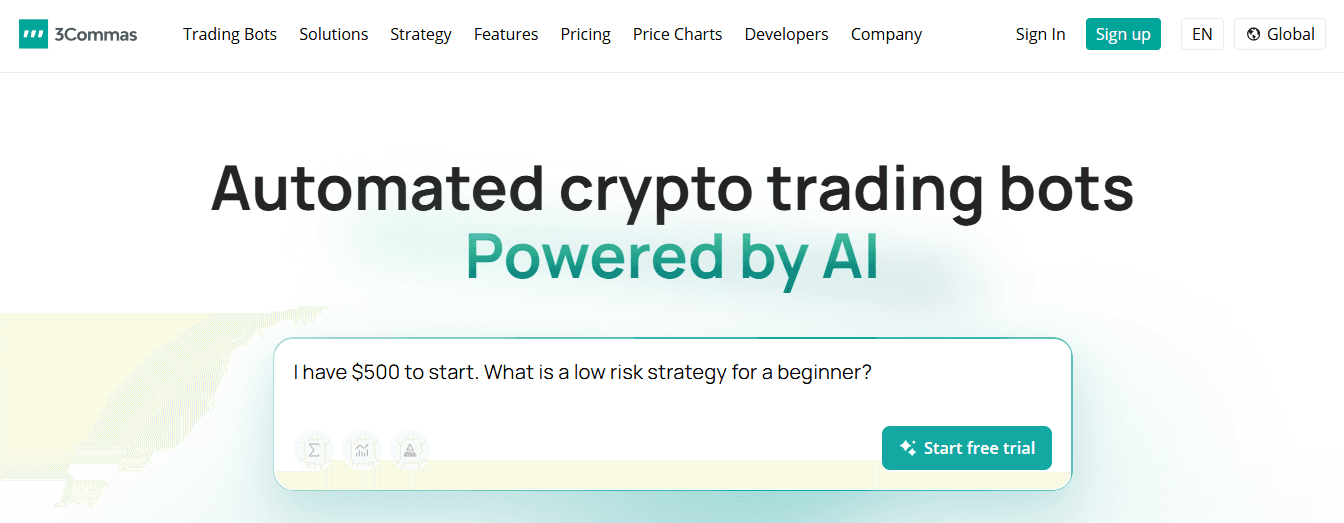
After testing structured retail platforms, 3Commas stands out for its DCA and grid logic, which non-developers can deploy quickly.
Strengths
Mature SmartTrade conditional orders
Broad exchange support
Clear templates for scaling a disciplined DCA/grid plan
Trade-Offs
Limited low-level customization compared with developer platforms, and execution depends on the quality of the exchange API.
Setup Tip
Pair 3Commas with an exchange that has deep liquidity for your pair to reduce slippage.
3. Cryptohopper

The same pattern shows up with strategy marketplaces, and Cryptohopper packages that idea with social copying and indicator-driven templates.
Strengths
Easy-to-copy strategies
Built-in indicator combinations
Templates for beginners who want algorithmic exposure without coding
Risk
Performance varies widely by strategy author, so verify live track records rather than relying on backtests.
Operational Advice
Treat marketplace strategies as hypotheses, not finished systems. Monitor fills and refine risk parameters.
4. Bitsgap
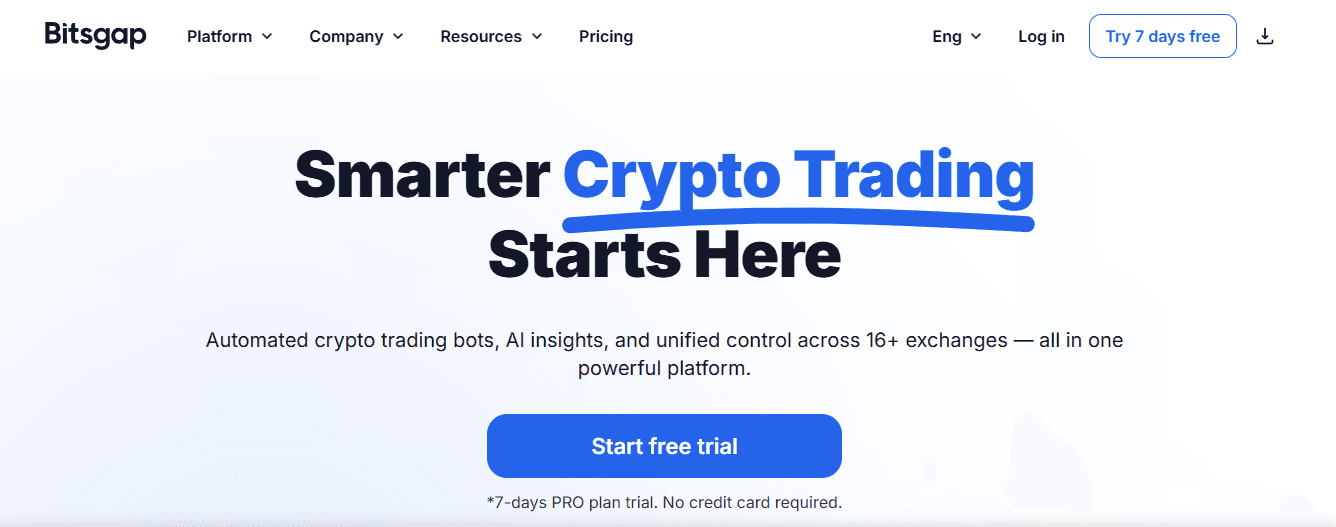
If your goal is to spread capture and range automation, Bitsgap focuses on grid and cross-exchange arbitrage tools built around spread monitoring.
Strengths
Multi-exchange grid setups and a UI that highlights arbitrage opportunities; use case: range-bound markets and spread harvesting.
Drawback
Grids suffer in strong trends and require active parameter tuning.
Practical Setup
Test grid width against average volatility over a 30-day window before committing capital.
5. WunderTrading

Constraint-based thinking applies here: when your strategy relies on TradingView chart alerts, WunderTrading maps those alerts directly to execution.
Strengths
Near-instant execution from TradingView alerts, copy trading, and futures support;
Fit
Discretionary traders who already use chart alerts. Watch for alert-to-execution delays and false signals during volatile candles, and use confirmation filters.
6. Pionex

Think of Pionex as an exchange with robots built into the factory floor; bots are native, so deployment is fast and simple.
Strengths
One-click grid and DCA bots with no external APIs, low friction for beginners.
Limitations
You trade within a single ecosystem, so cross-exchange arbitrage or bespoke routing is limited.
Risk Management
Treat built-in bots as execution tools, not black boxes, and check historical performance across market regimes.
7. TradeSanta

Problem-first: traders who just want cloud-hosted templates and minimal settings choose TradeSanta.
Strengths
Crisp UX
Fast template deployment for long or short bots
Cloud reliability
Downsides
Fewer advanced features for sophisticated risk controls, so it is better as an onboarding step than a permanent core execution layer.
Operational Tip
Use TradeSanta while developing rules, then migrate to a higher-control environment for scale.
8. HaasOnline

If you need full customization, HaasOnline gives it, with a scripting language and deep backtesting.
Strengths
HaasScript, advanced order types, and extensive simulation options make it the developer’s choice.
Tradeoffs
Steep learning curve and more day-to-day maintenance. Execution matters here because latency and routing shape results. Research shows that AI trading bots can execute trades 1000 times faster than a human trader, which means platforms that let you fine-tune execution can convert strategy edges into real fills.
9. Stoic AI
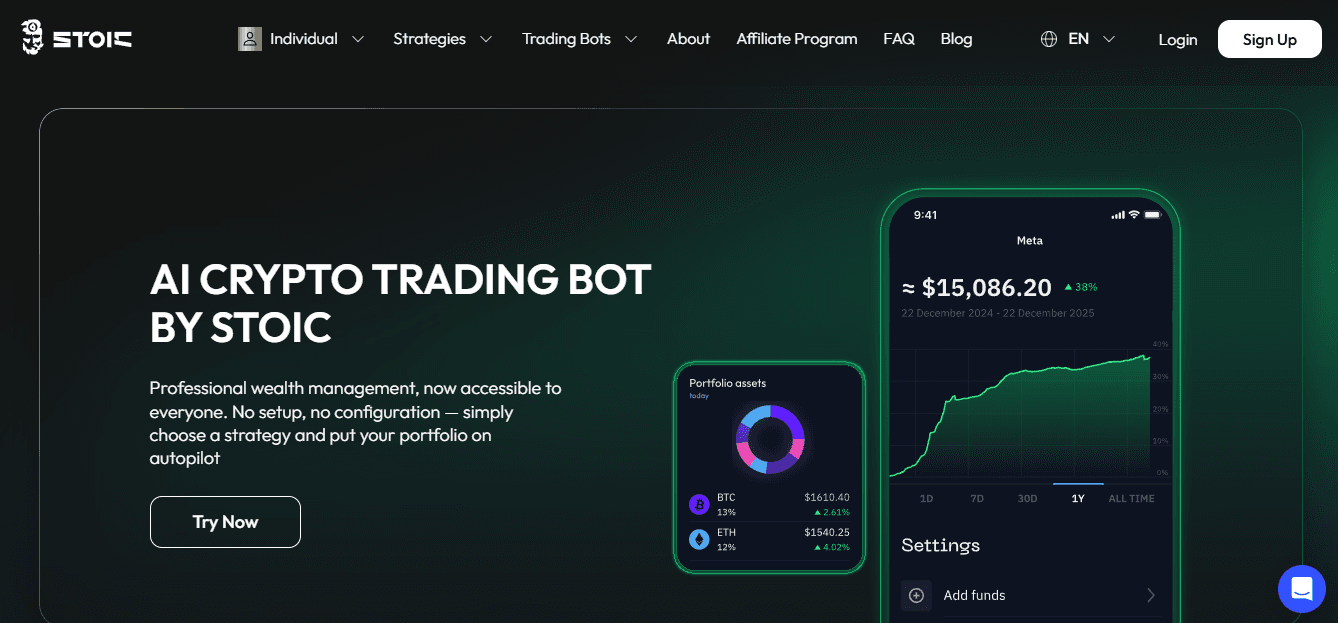
Constraint-based investors prefer Stoic AI when they want portfolio-level allocation decisions rather than frequent trade execution.
Strengths
Passive, rules-driven rebalancing tuned to risk bounds
Fit
Hands-off users seeking equity exposure without building tactical signals.
Tradeoff
Less control over individual trade timing and limited exchange coverage.
Monitoring Advice
Check rebalancing frequency and tax implications for your region.
10. AlgosOne

After evaluating turnkey AI services, AlgosOne appeals to users seeking hands-off models with minimal inputs.
Strengths
Multi-asset models and white-glove simplicity.
Weakness
The opacity of decision-making can frustrate experienced traders who want auditability.
Practical Caution
Demand transparent performance logs and on-chain proof of fills before allocating significant capital.
11. Gimmer

Pattern recognition drives Gimmer’s value, with ML-adaptive strategies tuned for arbitrage and recurring patterns.
Strengths
Model adaptation and simplified onboarding for pattern-based approaches.
Limitation
Machine learning models will drift as market regimes change, so continuous retraining or supervision is necessary.
Rule Of Thumb
Schedule monthly reviews of model behavior and parameter drift.
12. Hummingbot
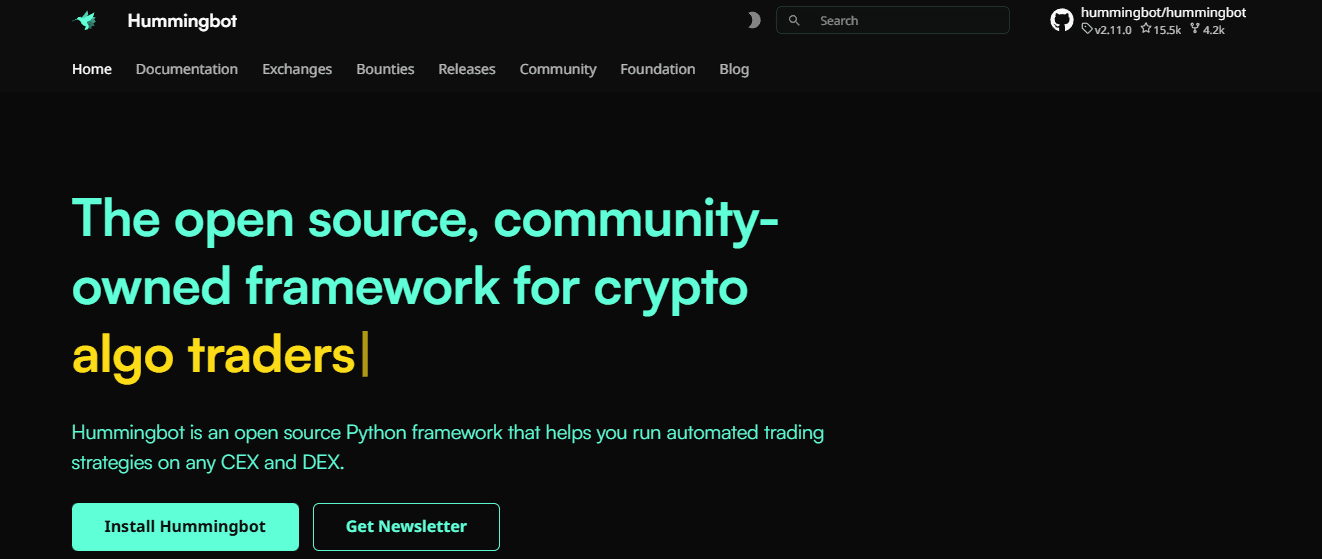
When transparency and control matter, Hummingbot provides an open-source execution bench that you host and maintain.
Strengths
Customizable market-making and arbitrage strategies, support for decentralized and centralized venues, and full auditability.
Cost
Requires technical ops time and server management.
Analogy
It is like renting a laboratory bench where you control the instruments and reagents; you get power, but you also provide water.
Operational suggestion
Automate monitoring alerts and run nightly sanity checks on fill rates.
13. Coinrule
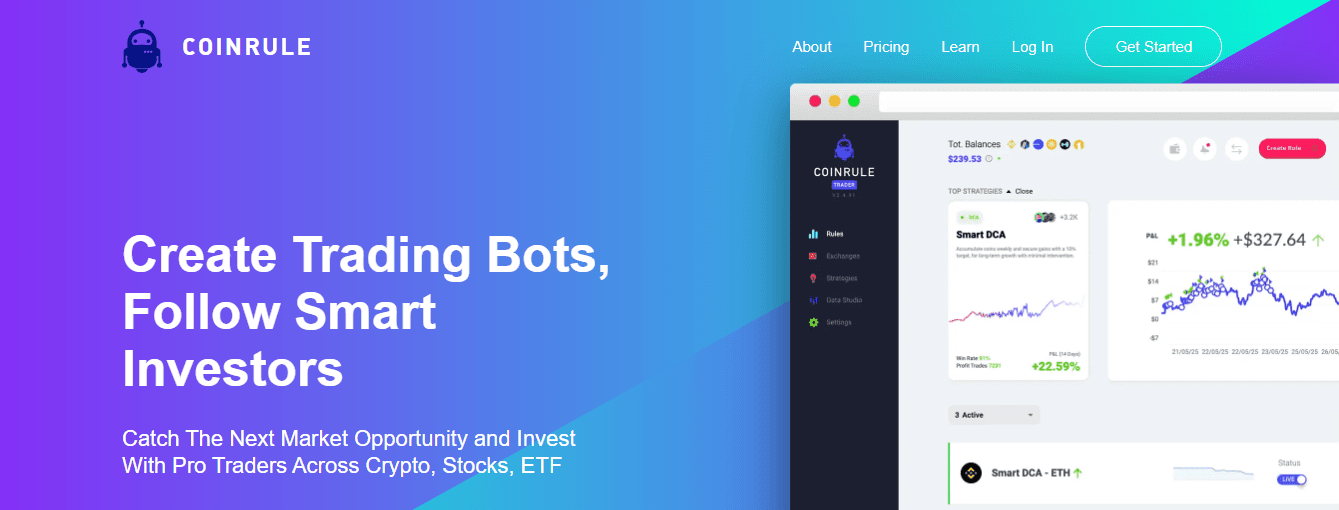
The key appeal of Coinrule is its no-code rule builder, which exposes logic explicitly through if-then-else rules.
Strengths
Transparent rule execution and AI-assisted templates for quick setup. The business case is clearer when you consider that AI trading bots have reduced human error in trading by approximately 40%, demonstrating that structured rule builders reduce common manual mistakes and order-entry slip-ups.
Caveat
Templates are helpful, but you still need to test them live and verify fills.
The Fragmentation Tax: Why Modern Trading Demands Unified Execution
Most traders manage this by stitching together exchanges, wallets, signal chats, and standalone bots because it feels flexible and familiar, especially early on.
As strategies scale, that familiar approach creates hidden costs:
Execution leaks
Inconsistent routing
Multiplied operational risk that quietly erodes returns.
Platforms like Bullpen offer a different path, focusing on centralized on-chain execution with:
MEV protection
Real-time fee optimization
Social discovery
It helps reduce execution complexity while preserving custody and visibility.
The Execution Gap: When Perfect Logic Meets Imperfect Markets
A short anecdote to keep this practical: I once saw a strategy that looked perfect in backtesting fail because fills were routed poorly during a short squeeze, teaching me that clean logic plus messy execution equals disappointment. That tension between code and execution cannot be resolved by templates alone. But the real reason this keeps happening goes deeper than most people realize.
What These Bots Are Actually Good At

Bots are best thought of as high-fidelity instruments, not prophets. They excel at precise, repeatable market tasks you can define and measure, they turn messy microstructure into reproducible data, and they let you run experiments at a scale and speed a human simply cannot match.
What Exact Tasks Do Bots Handle Better Than A Person?
They dominate order choreography:
Splitting large orders into TWAP or VWAP slices
Placing staggered limit ladders to capture passive liquidity
Adjusting fill tactics across venues based on live depth and latency
They also run continuous pre-trade simulations that estimate expected slippage and maker versus taker outcomes before a single fill, which gives you a defensible expectation for execution quality rather than wishful thinking.
How Do Bots Help You Learn And Iterate Faster?
Think of bots as automated labs for testing hypotheses.
You can:
A/B test execution tactics across identical market windows
Log every microfill, and compare realized slippage
Fill rates
Realized pnl with statistical rigor
That turns anecdotes into evidence by quantifying whether a change in routing, order size, or fee bidding actually moved the needle.
Why Are Bots Useful As Risk Enforcers?
This pattern appears consistently among discretionary and systematic traders:
When bots enforce position sizing and hard stop rules
Impulsive risk creep stops
Behavioral drift is eliminated
But that safety only holds when the rules include circuit breakers that pause activity during extreme regime shifts; otherwise, the discipline is mechanical and brittle.
How Do Bots Improve Execution Economics At A Micro Level?
They implement dynamic fee bidding, adjusting priority fees or on-chain tips in real time to balance urgency and cost, and they can opportunistically capture maker rebates or preferential routing when latency and liquidity align. They also monitor funding rates and funding-rate differentials to automate small, persistent arbitrage or hedging moves that add up over time without constant manual oversight.
Where Do Bots Become Measurement Tools Rather Than Decision Makers?
Bots provide verifiable telemetry, enabling on-chain auditing of fills and routing choices and the creation of provable leaderboards and performance dashboards. This turns execution into an auditable process, not a set of unverifiable claims, which traders value because it converts confidence into traceable records.
Infrastructure as Alpha: Why Unified Execution Outperforms the ‘Stitched’ Stack
Most traders stitch together exchanges and scripts because that feels familiar and flexible. That works until hidden costs compound, like fragmented routing, duplicated monitoring, and inconsistent fee optimization. Platforms such as Bullpen offer an alternative path that centralizes:
Execution telemetry
Real-time fee optimization
MEV-aware routing
It compresses the operational friction while preserving custody and verifiable performance.
How Should You Decide What Tasks To Automate?
If a task is repetitive, measurable, and bounded by clear rules, automate it. If it requires reading narrative changes, judging crowd psychology, or adapting to unseen regime shifts, keep a human in the loop. That rule of thumb keeps bots doing what they do best, while people handle judgment calls.
The Mirror Effect: How the Efficiency of 2025 AI Sets a New Standard for Trade Execution
According to the Chatbot Report, 67% of users prefer chatbots for quick answers. People clearly value fast confirmations, and that same demand drives traders to prefer instant, verifiable execution checks. Also, according to the same article, chatbots can handle 80% of routine customer questions, which mirrors how automation should take over routine execution tasks, allowing humans to focus on judgment and strategy. That apparent efficiency is comforting until the next part exposes what automation cannot forgive.
Where AI Trading Bots Commonly Break Down

Bots fail where their assumptions meet messy reality:
Bad inputs
Stale objectives
Brittle execution plumbing
Operational blind spots
You can build an elegant model and still lose money if the data feeding it, the decision hygiene around it, or the trade plumbing is unreliable.
Why Do Data Feeds And Labels Collapse A Strategy?
Feeds arrive with jitter, missing ticks, and inconsistent timestamps, and label noise silently trains bad behavior. When exchange feeds disagree, or on-chain signals are mis-timestamped, a bot learns patterns that never existed in live markets and then acts on them at scale. According to Core Devs Ltd, over 50% of AI trading bots struggle with data inaccuracies, which underlines how dominant feed and label quality is as a failure vector, not a fringe problem.
How Does Model Drift Actually Look In Production?
Models tuned to one regime stop behaving predictably when participation, volatility, or fee structures shift. Feature importance shifts; thresholds that once separated winners from losers blur; and retraining cadences lag the market by days or weeks. The practical consequence is not slow decay, it is brittle flips: strategies that were 80 percent cashflow generators become rapid loss centers without warning. According to Core Devs Ltd, approximately 30% of AI trading bots fail to adapt to sudden market changes, indicating a systemic gap in adaptive regime detection and retraining practices.
What Operational Failures Quietly Eat PNL?
API cancel latency, rate limits, and partial-fill handling create a mismatch between intent and exposure. A cancelled order that does not cancel can turn a hedged position into naked risk inside a single candle. Key management mistakes, unaddressed software updates, or misrouted orders during peak congestion cause losses that appear to be bad alpha but are actually orchestration errors. Treat these as infrastructure bugs, not strategy problems.
When Automation Amplifies Human Error, What Happens Next?
Automation magnifies whatever objective you give it. If you reward short-term win rate rather than drawdown control, the bot automatically scales the wrong behavior. Copying a top performer without position-sizing discipline concentrates risk so that a single market shock can wipe out an entire follower cohort. That feeling of helplessness that traders report, the exhaustion when steady gains become sudden, correlated drawdowns, is not mysterious. It is the predictable result of unchecked automation and herd behavior.
The Unified Execution Advantage: Eliminating the 'Fragmentation Tax' in 2026
Most traders manage this by stitching together exchanges, bots, wallets, and signal groups because that approach feels familiar and flexible. That works early, but as strategies scale, fragmentation creates hidden costs: routing delays, duplicated monitoring, and invisible execution leakage that compounds into steady slippage. Solutions like Bullpen offer a different path: centralizing on-chain execution with MEV protection and real-time fee optimization, and offering verifiable leaderboards so social discovery is backed by on-chain proof rather than screenshots, reducing standard operational failure modes while preserving custody.
How Do You Detect Failure Before It Becomes Catastrophic?
Instrument everything at fill level, not just PNL. Monitor cancel-to-fill latency, the ratio of maker to taker fills, and discrepancies between expected slippage and realized slippage during identical market windows. Run shadow tests on your live model as it makes decisions. Still, you replay orders to a testbook first, and set hard circuit breakers that pause execution when realized behavior departs from expected metrics for consecutive intervals. Think of it as adding behavioral checkpoints to a machine, so the bot cannot exceed the guardrails you intentionally set.
Beyond the Dashboard: Why Observability is the Only Safeguard Against ‘Silent Alpha Erosion’
A bot without operational telemetry is like a high-performance engine with no gauges; you can only detect overheating after the block cracks. Gauges turn near-misses into manageable maintenance. That pattern of quiet technical failures changes how you should evaluate the next wave of tools and signals, because the surface metrics lie, and the real story lives in the plumbing. That’s not the end of the problem; it’s where the next, deeper question begins.
Related Reading
The Real Shift: From “Best Bot” to Market-Aware Trading

The shift is simple and decisive: traders stopped searching for a single, universal “best bot” and began orchestrating portfolios of market-aware agents, human checks, and live social signals to decide when to run, pause, or reweight strategies. That change puts judgment back where it belongs: with conditional systems that adapt to the regime, not with fixed automation that assumes one size fits all.
How Do Traders Actually Stop Chasing A Single Bot?
This pattern appears across discretionary and systematic desks: instead of betting everything on a single script, traders split capital across specialized bots, each optimized for a narrow condition, and add a lightweight regime detector to gate activity. That way, a scalper runs only in high-liquidity, low-latency windows; a mean reversion bot takes over in low-volatility ranges; and a momentum agent runs during trending squeezes, with exposure caps and cooldown timers preventing cascade failures. No single tool tries to be universal, which is why Tickerly, “75% of traders have shifted from using a single ‘best bot’ to employing multiple market-aware bots,” captures the new operating model.
What Does A Market-Aware Stack Actually Look Like?
A practical stack layers three things, each with clear rules.
A regime layer that signals volatility, funding rate divergence, order-book depth, or on-chain whale flows.
Specialized execution agents tuned to one microtask, such as maker capture, liquidity-taking, or funding arbitrage.
A telemetry and guardrail layer that enforces position limits, cancel-to-fill thresholds, and automatic pause conditions when fills diverge from expectations.
That approach is not theoretical; it improves outcomes in live trading, as the GoMoon.ai Blog reports: “Market-aware trading strategies have increased trading efficiency by 30% compared to traditional methods,” indicating measurable efficiency gains once strategies are regime-aware.
Why Does This Feel Different And Emotionally Safer?
It addresses the common frustration traders experience when backtests fail in live markets. It is exhausting when a bot that performed flawlessly in simulation turns a steady run into a wipeout because the market structure has changed. The multi-agent approach reduces that exhaustion by turning catastrophic single-point failure into manageable reallocations; you lose fidelity at the margin, not everything at once. This is pattern-based expertise: modular, observable strategies help you learn and recover faster.
Infrastructure as Alpha: Why Unified Execution Outperforms the 'Stitched' Stack
Most traders still glue together wallets, exchanges, and signal chats because it feels low-friction and familiar. That works early, but fragmentation hides latency, routing tax, and coordination overhead as you scale. Platforms like Bullpen provide an alternative path, centralizing:
On-chain execution with MEV protection
Real-time fee optimization
Verifiable leaderboards
It simplifies orchestrating multiple agents, preserves custody, and reduces execution leakage that would otherwise erode small edges.
How Do You Operate A Market-Aware Stack Without Multiplying Operational Risk?
Use strict rules and short feedback loops. If a regime detector flips, move only a predefined fraction of capital, run a shadow test for one market cycle, then commit more if fills match expectations. Instrument cancel-to-fill latency, maker versus taker ratios, and realized slippage at the trade level, not just PNL. Require a social-proof checkpoint for copying: verify on-chain fills and leader consistency before following a trader's full sizing. Think in terms of constraints: if you need ultra-low latency, allocate a separate fund; if your goal is steady carry, prefer maker-only allocations. These tradeoffs keep complexity under control.
The Orchestrator’s Edge: Moving from Solo Automation to Market Orchestration.
Think of the new workflow like a conductor guiding an orchestra, not a soloist forcing every instrument to play the exact phrase. Each agent has a score and a cue; the conductor watches the room and signals when to bring parts in or mute them, and the audience sees the performance in real time, so everyone learns which passages work and which do not. That question you keep circling, about whether tools can actually make these choices for you, is where the next section gets interesting.
Buy Crypto Today with Bullpen
We juggle wallets, bridges, bots, and signal chats until routing friction and execution leakage quietly eat our edge. Platforms like Bullpen centralize tokens, Hyperliquid perps, Polymarket, copy trading with verified PNL, and AI trading bot tools into one noncustodial app so you can follow top performers, run algorithmic or automated strategies, and buy Crypto with Apple Pay or a bank transfer while seeing clearer execution telemetry. Deposit today to earn a 500-point bonus and get a free introductory call when you fund $1,000 or more, so you can start trading smarter with Bullpen.
Related Reading
Last Updated:
February 7, 2026