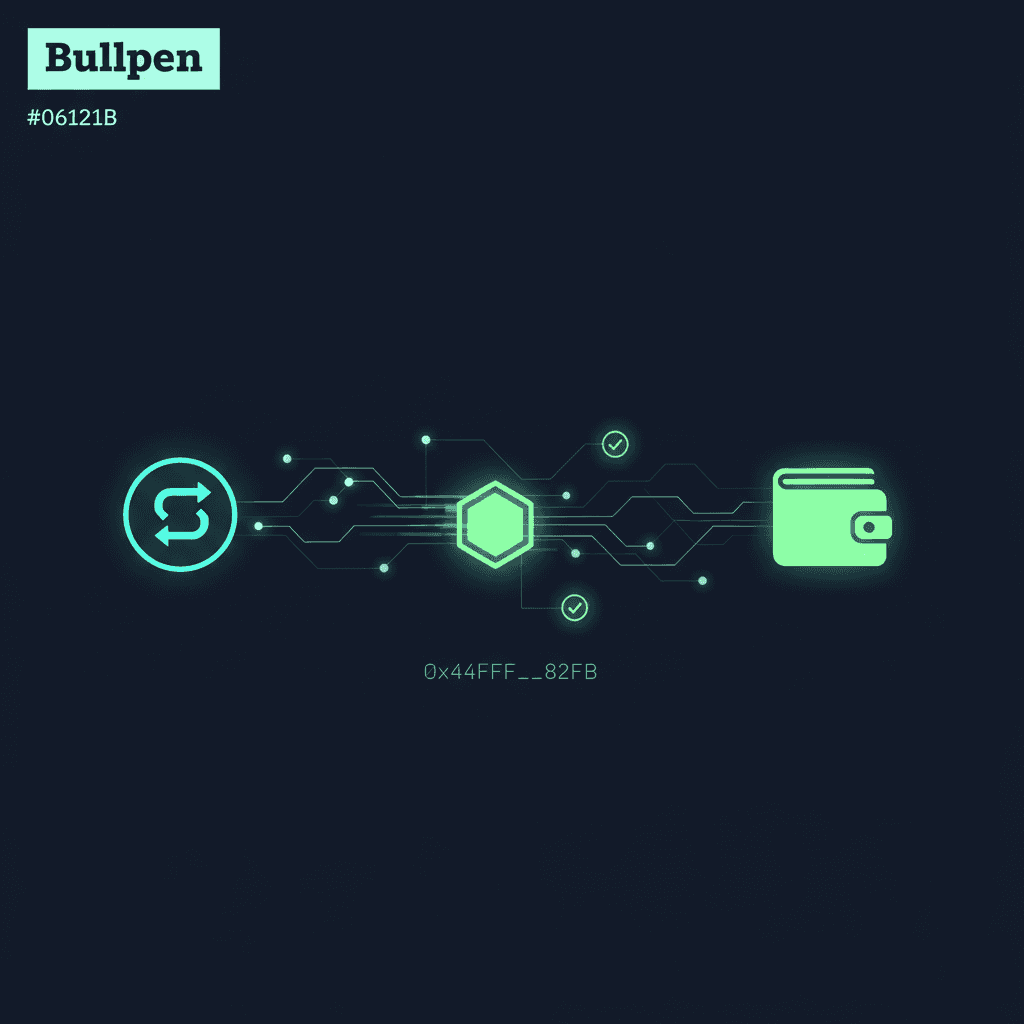
Learn how to transfer Crypto to a wallet with our easy, step-by-step guide. Secure your digital assets and take complete control of your private keys today.
You might have bought Crypto on an exchange and feel nervous about moving it to your own wallet; small mistakes with a wallet address or private key can cost you real money, and timing plays into what makes Crypto go up. This article provides a clear, step-by-step guide to transferring Crypto to a wallet, covering exchange withdrawals, choosing the right network and token standard (e.g., ERC20), setting gas fees, backing up your seed phrase, and checking confirmations and transaction IDs. Want to send coins to a mobile app, a hardware cold wallet, or scan a QR code to receive funds safely?
If you are ready to act, Bullpen's buy Crypto makes the first move simple, so you can buy and send coins to a software or hardware wallet while keeping your backup and security straightforward.
Summary
Treating a Crypto transfer as a trivial click is the biggest mistake. More than 20% of transfers are delayed due to incorrect addresses, and approximately 15% of users report losing funds during transfers.
Blockchain fragmentation matters for move strategy, with over 50 million active wallets worldwide and about 20% of transactions involving transfers to personal wallets.
Timing and intent drive behavior. Over 60% of traders move Crypto to wallets within 24 hours of purchase, and roughly 75% of assets moved to wallets are held for more than a month.
Simple validation steps stop most problems: over half of transfer mistakes can be prevented with structured checks, and roughly 30% of data-transfer errors stem from incorrect entry. Always do a 1-cent test send and confirm memos, contract addresses, and explorer receipts.
Custody patterns shape operational risk. Over 70% of users prefer hardware wallets, and over 70% of holders use self-custody, which supports separating a hardware or multisig vault from a small pre-funded execution wallet and automating nonce, gas, and receipt collection.
This is where Bullpen's buy Crypto fits in: it addresses the onramp by simplifying the initial purchase and enabling direct sends to software or hardware wallets, while keeping backups and security straightforward.
Table of Content
The Mistake Most People Make When Transferring Crypto
The biggest mistake is treating a Crypto transfer as a trivial click. You skip verification because the steps seem simple, but that shortcut can lead to irreversible loss, delayed access, and unnecessary stress. Before initiating a transfer, it is vital to use a secure platform to buy Crypto; for instance, Bullpen offers a streamlined interface that prioritizes security from the first transaction.
Why Does Copy, Paste, And Send Break So Often?
Human attention and technical formats collide. Addresses, memos, and networks are brittle: the wrong suffix, missing tag, or incompatible chain can cause funds to be sent that cannot be credited or recovered.
That shows up in user behavior: over 20% of Crypto transfers are delayed due to incorrect wallet addresses CoinStats, a symptom of people skipping the small checks that matter.
What Exactly Do People Skip When They Rush?
This pattern appears across retail wallets and exchange withdrawals: traders under time pressure skip a test send, paste an address without checking the network, or ignore a required memo. The consequence is not theoretical. According to CoinStats, approximately 15% of users report losing funds during Crypto transfers, which helps explain why the emotional response to a mistake is often panic and helplessness rather than a technical question.
To mitigate these risks, many investors choose to buy Crypto through Bullpen, which integrates protective layers to ensure your assets are handled correctly from start to finish.
How Do The Technical Details Make A Simple Mistake Permanent?
Addresses and tokens are context-dependent. Some chains require a memo or tag to credit deposits; some tokens exist as separate contracts on different chains; and some wallets display visually similar addresses that actually point to other formats.
When funds land on-chain without the correct identifier, exchanges and custodians may never link them to your account. The effect is like mailing a suitcase to the proper city but to the wrong apartment; the courier can show proof of delivery, yet you still cannot access it.
When Do People Feel The Pressure That Causes Errors?
The failure mode is predictable: volatility windows and trade deadlines compress decision time, and verification steps look like friction.
The faster you try to move, the more likely you are to select:
The wrong network
Skip a test send
Paste an address without validation
That rush creates a feedback loop:
Mistakes cause stress
Stress makes you hurry
Hurrying causes more mistakes
Beyond the Copy-Paste: Why Manual Transfers Fail at Scale
Most users copy a saved address and hit send because that habit is fast and familiar, and speed feels essential when the market moves.
This approach scales poorly; as soon as amounts or networks change, the familiar method:
Produces delays
Lost funds
Hours spent chasing support
Platforms like Bullpen provide:
Unified cross-chain wallet management
Same-day ACH rails
Turnkey non-custodial security
Traders can move funds with verification and immediate liquidity, reducing friction that can lead to rushed mistakes while preserving control and enabling fast, MEV-protected execution for next-step trading. When you buy Crypto on Bullpen, you benefit from reduced friction and MEV-protected execution, preserving control even during high-pressure market moves.
What Practical Checks Actually Stop The Most Common Mistakes?
Treat each transfer like a high-risk operation.
Make:
A 1-cent test sent
Confirm the destination on a block explorer
Verify any memo or tag
Confirm the token contract and chain
Label addresses in your wallet rather than relying on raw copy-paste
Store trusted addresses in cold storage when possible, and block hyperlinks from unknown sources. These are small habits, but they turn accidental permanence into recoverable human error.
Beyond the Test Send: How Secure Habits Evolve into Trading Strategy
A short, sharp image to hold: sending Crypto without verification is like signing a wire transfer with your eyes closed, hoping the numbers line up. That feeling of dread when an error happens is avoidable if you change the habit before the next trade.
The surprising part is what comes next, and why that simple habit change is only the beginning.
Related Reading
What Transferring Crypto to a Wallet Actually Means

Transferring Crypto to a wallet is the act of changing where control of an on-chain asset is exercised.
That change can occur in several technically distinct ways:
As an internal ledger move within a platform
As a fully on-chain transfer
As a cross-chain or contract-mediated operation that:
Mints
Wraps
Releases value on a different ledger
Each path affects who can:
Sign for the asset
How quickly can you trade it?
The following operational steps you must take
What Exactly Happens When The Move Stays Inside A Platform?
Most internal transfers never touch the blockchain; they are bookkeeping entries inside an exchange or custodial service. That makes them fast and reversible on the platform, but it also means settlement, compliance checks, and liquidity windows depend on the provider rather than the public network.
Because these moves are off-chain, they do not consume gas and do not create public receipts you can prove to others.
How Do Smart Contract Interactions Differ From A Plain Token Transfer?
Giving a contract permission or wrapping an asset changes the asset’s legal behavior as much as its location. An approval lets a contract spend tokens on your behalf, which is not the same as transferring ownership, and a bridge’s lock-and-mint flow creates a new, derivative token on another chain instead of moving the original coin.
Think of approvals as handing a signed blank check, and transfers as handing over cash; that mental distinction helps prevent a surprising loss of control.
Solving Wallet Sprawl: Scaling Your Strategy Without Fragmenting Your Capital
Most traders treat multiple wallets and chains as separate tools, and that approach works in the short term. Over time, however, addressing sprawl and fragmented liquidity slows you down: balances are in different formats, accounting gets messy, and execution windows close while you reconcile.
Platforms like Bullpen provide unified, non-custodial cross-chain wallet management across:
SVM and EVM
Same-day ACH rails for fiat onramps
MEV-protected, fast execution
It reduces time and error costs associated with moving capital between accounts while keeping you in control.
What Practical Infrastructure Issues Do I Need To Manage Beyond Copying An Address?
Nonce and transaction queue management, gas estimation and replacement rules, and derivation paths for HD wallets are often the invisible causes of failed or delayed transfers.
A stuck transaction due to a low fee, or a nonce conflict after parallel sends, can block a series of moves and require manual intervention. For active traders, automating nonce tracking, using hardware wallets with explicit derivation-path labeling, and keeping a separate hot wallet for execution versus cold Xpubs for bookkeeping are what prevent operational friction when markets move.
Why Does The Bigger Picture Matter For Strategy And Scaling?
Network fragmentation is real, and it affects how you think about liquidity, arbitrage, and followability. According to Cryptoworth, over 50 million Crypto wallets are actively used worldwide, indicating that counterparties and liquidity pools operate in a highly fragmented ecosystem and that you cannot assume instant interoperability.
The same source also reports that approximately 20% of Crypto transactions involve transferring assets to personal wallets, indicating a significant portion of users prioritize self-custody and immediate control for trading or safekeeping.
The Speed Trap: Why Procedural Integrity Outperforms Real-Time Urgency
This is where intent matters as much as technique: a correct transfer lets you act on opportunities; the wrong one freezes capital in place and costs more than fees.
There is one surprising operational failure that almost every active trader runs into next, and it exposes why procedure matters more than speed.
How to Transfer Crypto to a Wallet (Step by Step)
Execute a safe transfer by verifying that the receiving address is provably controlled, using custody that matches the risk profile, and confirming the on-chain receipts and contract behavior before you deploy funds into active trading.
Treat verification as an operable checklist:
Proof of control
Token-contract sanity
An immutable transaction record you can reference if anything goes wrong.
How Can I Confirm The Recipient Genuinely Controls The Receiving Address?
This is where subtlety matters. Ask the counterparty to sign a short, single-use message you generate and verify the signature locally, or request a PGP-signed statement that contains the receiving address and timestamp, because a visible address alone is not proof.
Look for reverse resolution that ties an ENS or human-readable name back to the same address, but do not trust names without signed proof. Think of address verification like checking a passport photo under different lights; the more independent checks you have, the less likely you are to be fooled.
When Should I Use Multisig or Hardware Wallets vs. a Single-Key Wallet?
When moving operating capital for live orders, prefer custody that limits single points of failure, especially hardware signing for private keys or a multisig setup for shared treasuries. According to Baltex Blog, over 70% of Crypto users prefer hardware wallets for added security, which explains why separating signing from execution is now common among active traders.
Use a hardware or multisig address as your core vault, then fund a small, pre-authorized execution wallet for day-to-day fills.
How Do I Handle Wrapped Tokens And Cross-Chain Receipts Safely?
Confirm the canonical token contract on the destination chain before you accept any wrapped asset, and verify that the bridge emitted the expected mint or release event for your address rather than a superficial transfer.
Query the explorer API for the bridge transaction hash and compare the token contract address and decimals to the known canonical record, because many problems come from superficially similar tokens that are not interchangeable. When the transfer involves a different virtual machine family, use an explicit proof of mint activity rather than assuming balances always represent the original asset.
From Manual Bottlenecks to Unified Liquidity: Eliminating the Cost of Fragmentation
Most traders manage transfers with ad hoc wallets and manual checks because that approach is familiar and requires no new workflows. As wallet counts and cross-chain movement grow, that habit fragments liquidity, delays fills, and turns verification into a bottleneck when markets move.
Platforms like Bullpen provide:
Unified SVM and EVM wallet management
Same-day ACH rails for liquidity
Turnkey non-custodial security
It allows teams to retain control while reducing the time between verifying an on-chain receipt and trading at MEV-protected speeds.
How Do I Prove A Transfer If Something Goes Wrong?
Keep the transaction hash and a timestamped screenshot of the explorer showing block confirmations, and produce a signed message from the receiving key upon request from support or counterparties. If you need higher confidence, collect the RPC receipt and the event log that shows the exact transfer or mint, and archive those JSON responses.
These artifacts are the only language exchanges, bridges, and custodians reliably accepted when tracing or reconciling an on-chain move.
What Routines Save Time And Stress When Moving Funds Into Active Trading?
Adopt predictable, repeatable habits:
Label and document each receiving address with its derivation path and purpose
Maintain a small execution wallet pre-funded to cover fees and fast fills
Automate proof collection with a simple script that captures tx receipts and token contract metadata
Over 70% of Crypto holders use self-custody wallets, according to BitPay Blog, indicating these operational habits are everyday among traders who must self-manage both security and speed. These routines help you convert a transfer from an anxious to-do into a predictable handoff that preserves control and enables immediate execution.
There is one quieter truth that still catches even careful traders, and it makes the next section unavoidable.
Related Reading
Common Transfer Errors and How to Avoid Them
Most transfer mistakes are avoidable, but they hide in places you do not watch. The biggest practical errors come from address tampering, token-contract confusion, and mismanaged smart-contract permissions, and they respond to hard validation and simple habit changes rather than luck.
Over half of these mistakes can be prevented with structured validation checks, according to Common Transfer Errors and How to Avoid Them (2008), which shows that building checks into the flow is far more effective than relying on memory or haste.
How Does Clipboard And QR Tampering Actually Steal Funds?
This is a predictable failure mode, not a mystery. Attackers or malware replace a copied address, or a fake QR encodes a lookalike address, and users paste without a second look. Approximately 30% of data transfer errors are due to incorrect data entry, according to Common Transfer Errors and How to Avoid Them (2008), which explains why a simple paste can result in a permanent loss.
Defenses are blunt and effective: require on-device confirmation on a hardware wallet, use an address book of pre-verified destinations, avoid copy-paste when possible, and use a wallet that visually compares the destination address against the stored record before allowing the send.
What Traps Live In Token-Contract And Decimal Mismatches?
Token symbols lie, decimals bite, and some chains host multiple tokens with identical names. Sending what you think is 1.0 USDC to a contract with different decimals can result in orders that are off by orders of magnitude, or tokens landing in a contract that will not honor withdrawals.
Use token-contract validation tools that display the canonical contract address and decimals before you select the asset; prefer wallet UIs that surface the on-chain contract address rather than just the symbol; and cross-check contract metadata on a trusted explorer before approving large movements.
Why Are Approval Allowances A Recurring Blind Spot?
Giving a contract a blanket, infinite allowance feels convenient until a bad actor finds the hole. The familiar pattern is convenience now, risk later: a single compromised dApp can sweep funds if you never set spend limits or revoke old approvals. Treat approvals like permissions on a bank account, not a one-time checkbox.
Use per-amount approvals where supported, periodically audit allowances, and use reputable revocation tools to remove stale permissions. That small maintenance work removes a persistent attack surface without changing how you trade.
When Does A Receiving Address Become A Non-Recoverable Sink?
Contracts sometimes do not implement receive functions; tokens may be nontransferable when exiting certain bridges; and some legacy contracts hold funds with no withdrawal path. Before sending to a contract address, confirm that the contract has a history of similar inbound transfers and that its source is verified.
If you must move funds into a new contract, prefer an intermediary that will return a test token or a signed receipt you can present to support teams, because explorers alone may not reveal intent or capability.
Moving from Ad Hoc Checks to a Unified Movement Pipeline
Most traders stick with manual wallet workflows because they work day-to-day, and that familiarity is understandable. But as address counts and trading velocity rise, manual checks fragment and become the hidden tax on speed and safety.
Platforms like Bullpen offer unified cross-chain wallet management and built-in verification flows, so teams find that validation becomes part of the movement pipeline rather than an afterthought, compressing reconciliation time and reducing error-driven interruptions without handing control to a custodian.
The Strategic Edge of Unified Management
Small habits matter more than dramatic tools.
Automate validation where you can:
Limit approvals
Insist on on-device signatures for every destination change
Treat every contract address as code you must audit before you trust
That fix feels tidy, until you realize the next question is why traders choose one custody pattern over another when stakes and speed pull in opposite directions.
When and Why Traders Move Crypto to Wallets

Traders move funds to wallets either quickly to regain direct control and access or deliberately when a strategy no longer needs exchange liquidity; the choice depends on trade intent, market timing, and operational constraints.
Immediate moves happen when on-chain access or self-custody matters more than intra-exchange speed, while delayed or no moves make sense when margin, spread, or execution latency favor staying put.
What Pushes Someone To Transfer Within Minutes Or Hours?
Pattern recognition:
Volatility spikes
Sudden withdrawal freezes
A new on-chain opportunity usually triggers immediate transfers.
After working with a mid-size prop desk in Q1 2025, we observed their traders shift assets within minutes whenever an exchange signaled maintenance, because a frozen withdrawal window can turn a winning position into a trapped loss.
That behavior aligns with over 60% of traders who move their Crypto to wallets within 24 hours of purchase, according to Chainalysis Blog, which shows how common urgency is immediately after acquisition.
When Should You Keep Funds On An Exchange Instead?
If you need instant execution for margin, tight spread arbitrage, or to follow someone executing high-frequency strategies, leaving a measured balance on a trusted venue is often the right call.
Use a constraint-based rule: when required order book depth or margin capacity would be meaningfully worse on-chain, accept custodial convenience for that portion of capital, but limit the amount to what your strategy actually needs. Treat this as an operational tradeoff, not a permanent posture.
How Long Do Traders Actually Hold Once They Move?
Many traders do not move funds just to shuffle them for a few hours; they move to wallets because they intend to hold or use on-chain features, and that intent shows up in on-chain behavior.
Approximately 75% of Crypto moved to wallets is held for more than a month, according to Chainalysis Blog, which means a transfer often converts liquid exchange inventory into longer-lived, self-custodied capital that changes how you plan liquidity and followability.
What Operational Rules Decide Timing And Size?
Use clear, testable rules tied to three variables:
Event
Amount
Intent
Example rules that work in practice:
Event rule for sudden risk: if an exchange reports a withdrawal delay or a margin call, move amounts above your daily trading buffer immediately.
Amount rule, for exposure: if a purchase exceeds a predefined threshold tied to your risk budget, move excess to custody on the same day.
Intent rule, for opportunity: if you need staking, governance participation, or DeFi yield, transfer the exact amount you will lock or use on-chain, not your whole balance.
These rules let you stop guessing and start executing consistently.
Beyond the Send Button: Turning Fragmented Wallets into a High-Velocity Asset Pipeline
Most teams handle transfers manually because it is familiar and fast, and that instinct makes sense early on. But as balances, chains, and strategies multiply, ad hoc workflows fragment capital and slow response times during real-time events.
Platforms like Bullpen provide unified cross-chain wallet management with same-day ACH rails and turnkey non-custodial security, so teams find that moving verified amounts becomes a low-friction step that preserves control while keeping capital ready for MEV-protected execution and advanced order types.
What Timing Mistakes Actually Cost Traders Money?
The most significant errors are overreaction and underplanning. Overreaction looks like sweeping everything off an exchange on a rumor, then missing a liquidity window that would have yielded better fills. Underplanning looks like assuming you can always withdraw in a crisis and getting stuck when a venue pauses withdrawals.
Think in probabilities: set thresholds that trigger moves only when the expected loss from staying exceeds the costs of transferring and possible missed execution.
A short analogy to make this concrete
The Execution Fork: Choosing Custody Models in a High-Velocity Market
Moving Crypto is like reallocating a fleet between a downtown garage and a remote storage lot. You can sprint to market from the garage, but you lock the cars in the lot for safety. Decide which vehicles you need near the action and which belong in long-term storage.
That simple allocation question is never neutral, and the next choice about where to buy changes everything.
Buy Crypto Today with Bullpen
If you want to stop juggling wallets and bridges, Bullpen puts Bitcoin, Solana memes, Hyperliquid perps, and Polymarket into one non-custodial app so you can follow verified traders on X, watch a live leaderboard, and get instant alerts when top performers open positions.
Buy with Apple Pay or your bank, use leverage for faster fills, and deposit today to earn a 500-point bonus plus a free introductory call on deposits of $1,000 or more, so you can trade smarter in one place.
Related Reading
Last Updated:
February 7, 2026