
Bullpen’s vision is simple: all of crypto, one app. A single place to trade every relevant crypto market. But that’s just table stakes. Our vision is much larger. X is the endgame for the intersection of social and trading. Bullpen will supercharge this. Imagine making money while doomscrolling X. Imagine finding alpha and executing on it with a single tap. This is the vision we are building. This piece opens a thesis series that explains why we are building on top of X and the design constraints that follow. Every decision reflects deliberate intent and the scar tissue of features shipped, measured, and retired with real market feedback. We start at the intersection of social and trading because that is where much of the crypto alpha discovery already happens. This installment sets the frame for the rest of the series.
A Quick Aside: What is a Bullpen?

Behold, a Wall St trading floor in the 1980s.
I named the company Bullpen after the term used in corporate and trading floor vernacular for an open concept work area where analysts, traders, and managers sit together in rows of desks without walls. I have worked in this setup my entire career, from Wall Street internships to
ShapeShift’s Denver offices to Galaxy’s research desk. Bullpens compress learning and maximize communication, transparency, and speed of information flow. Those same attributes are what I wanted Bullpen, the product, to encode in its DNA, from backend architecture to the pixels users see and feel. Bullpen isn't just an app; it's a digital bullpen where ideas flow as fast as trades.
The Stall in Social Innovation: 10+ Years Since a New Social App Succeeded
From 2004-2016, social media exploded: Facebook, Twitter, Instagram, Snapchat, TikTok, and Discord reshaped how we connect. Today, they're daily rituals for billions of people. Each app had an outsized impact on how people connect, share, and consume content. However, something strange happened by the late 2010s. The incidence of breakout social media apps stalled. While there were some brief exceptions (Clubhouse and BeReal during COVID), none of them endured. Not even Meta could push Threads to relevancy as its 100M+ initial signups in 2023 fell by 80% just months later. Why has no new app sustained breakout success since TikTok (2019) and Discord (2017)? Three key forces explain this stall: the rise of recommender systems (the “For You” feed), the shift to private social graphs (group chats), and the entrenchment of incumbent platforms (which will further accelerate as AI usage increases). Let’s dig into each of these:
Algorithmic Takeover: From Follower-Following to For You Eugene Wei did a great job explaining the magic of recommender systems in his 2020 essay. The shift from Follower-Following feeds to algorithmically-driven For You feeds, pioneered by TikTok, completely changed the game. Recommender systems, which power For You feeds, do a few things orders-of-magnitude better than Following-Follower graphs:
Content creators can blow up with small followings
Users can discover interesting content without thinking
The endless content well never dries up (even if you’re a brand-new account)
These advantages are compound when accounting for the cold-start problem (a would-be emergent social network’s primary kryptonite). Gone are the days where a new user needed to manually click through a bunch of interests during onboarding in order to produce a useful feed. TikTok and recommender systems implicitly learn user preferences after 20 or so swipes on the For You page. New users can join faster and retain at a clip. That brings us to the next point.
Incumbent Dominance: Walled Gardens Win Instagram’s Reels (2020) and YouTube’s Shorts (2021) observed these massive advantages afforded by recommender systems with (seemingly) 0-downside, and they proceeded to swiftly replicate the TikTok model into their existing products. Reels and Shorts prioritize content discovery over anchoring content to people that the end-user manually followed. This creates a flywheel effect, incentivizing creators to distribute content where discovery has the greatest top-of-funnel impact (existing apps with massive userbases who are being served content algorithmically 24/7). This flywheel simultaneously creates a death spiral for any emergent app, as new apps simply can’t compete with these hyper-optimized algorithms served to hundreds of millions of users. This keeps the supply and demand sides of content creation in check while end-users stay hooked on established platforms. Why join a new app when TikTok, Instagram, and/or YouTube already know what you’ll love?
Private Social Graphs: The Group Chat Era One of the least-discussed and most fascinating reasons behind the death of new social apps is the rise of group chats. While they’ve existed for a very long time, they started getting incredibly popular from the mid 2010s onwards. This shift in population-wide user behavior has meant that end-users no longer publicly post (unless it’s performative like an IG photo dump) and instead opt for private group spaces, whether that’s a group chat in iMessage, Telegram, Whatsapp, Instagram group chat, or Discord server. By 2019, Discord’s 100M+ monthly users marked a seminal moment that best captured this shift: New apps will struggle mightily to pull users from these intimate, entrenched networks with established usage patterns.
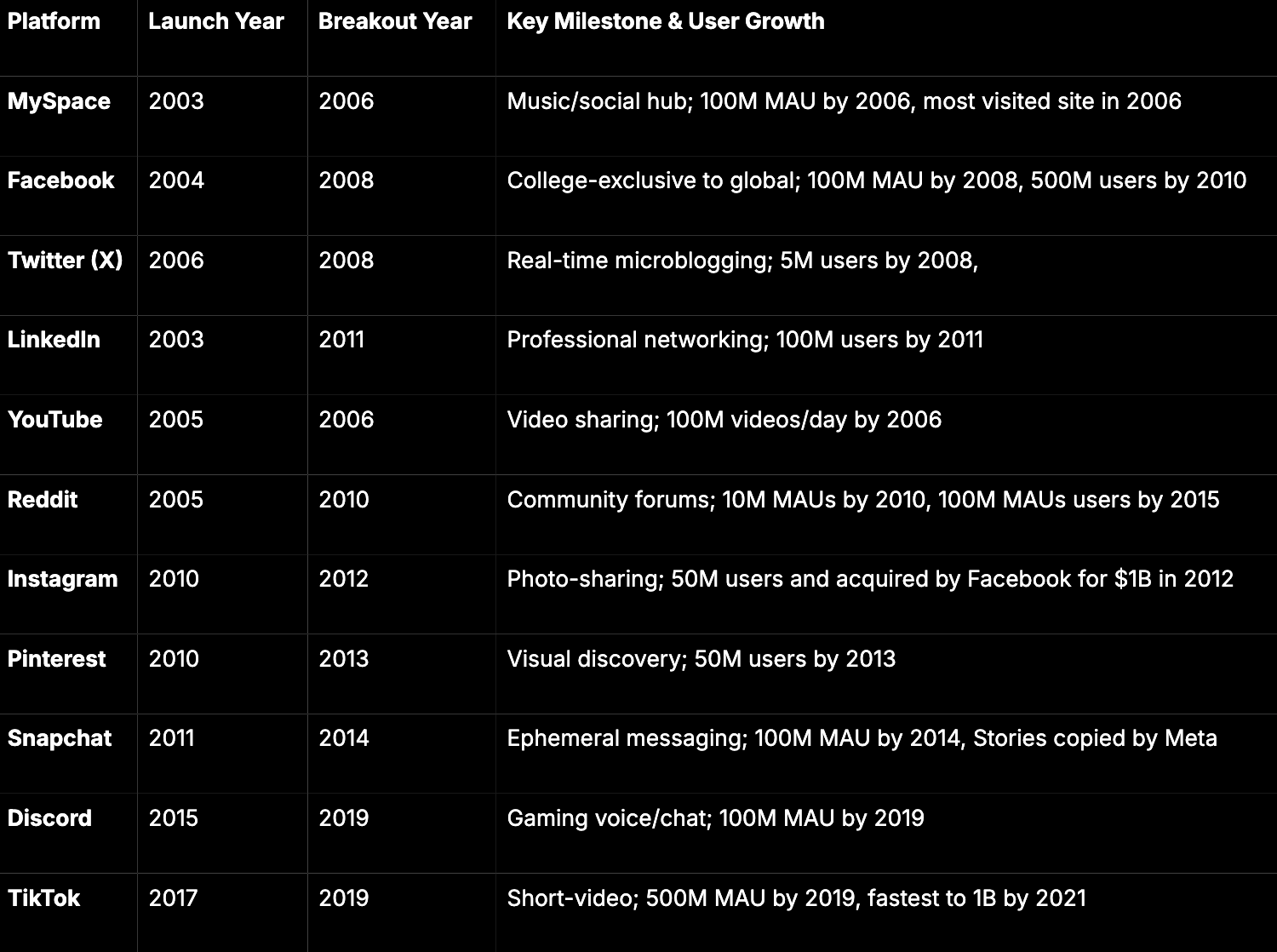
This table lists major social apps by launch year and breakout year. No breakout social network have emerged since Discord in 2015 and TikTok in 2017.
Why Video is Suboptimal for Trading-Centric Storytelling
The product tradeoffs each social media platform makes shape how users share and consume information. Each platform’s algorithm rewards distinct content:
Instagram: Polished, visual-heavy posts (Reels, photo dumps).
YouTube: Long-form videos with high watch time and retention for ad revenue.
TikTok: Short, viral clips tied to trends, maximizing session length.
X: Concise, data-driven insights or witty takes, amplifying sharp ideas.
Highlighting these intra-platform differences underscores that not all formats suit every domain. The best traders in the world are often thesis-driven and base their decisions on deep analysis of data and first-principles reasoning. This methodical approach clashes with the video-heavy bias of platforms like TikTok and Instagram Reels. Video is best suited for entertainment. It falls short for informational content for the simple reason that people, on average, don’t watch videos for education. Trading content, in order for it to be useful and pack actionable alpha, works best when expressed in text form:
Quality Trading Content Demands Depth. Video Recommender Algorithms Punish Depth Trading is cognitive and data-dense, requiring pauses to digest, reread, and verify. Text, with its ability to convey detailed charts or dense arguments in minutes, suits the slow, deliberate analytical style traders rely on to make informed decisions. While video excels for quick tips or market recaps, it rarely captures the nuance that top traders demand.
Additionally, Top traders, particularly those who are active on social media, are often anonymous. This is also at odds with video content. Ever notice that every single YouTube video has a thumbnail with a person’s face + reaction these days? It’s because thumbnails with heavily-emoted facial expressions convert better. People tend to click on videos that emotionally resonate with them. On X, however, the best ideas win. Pseudonymous accounts can thrive by simply sharing sharp insights via posts or charts (without doxxing). These same creators would not be able to easily replicate their success on a video-centric content feed that punishes anonymity. Even with recent advancements in realtime animated AI avatars or AI voiceovers, these tools feel more like a better mousetrap than a panacea for the fundamental problem facing ‘good’ content creators in the world of trading. While we do recognize that there is some very good trading-oriented content on video-based social networks, we think the supply differential between X and TikTok (or equivalent short-form video venue) for great content creators in the domain of trading is on the order of 10x or more (biasing X). This distribution may shift over time with AI tools continually breaking down barriers for creators, but that shift will likely take a while to materialize (if it ever does).
On the content consumption side, the best traders don't necessarily find alpha in videos (excluding long-form podcasts, which are fundamentally a different style of content than what recommender systems share on TikTok and other short-form platforms). Traders will instead scroll X for hours. In the TradFi world, they may pull up dozens of Bloomberg charts or pursue thematic pieces that read more like Berkshire Hathaway’s annual letters. All of these types of content share the attributes of being densely-packed with written reasoning. It’s very hard to compress thoughtful analysis and visually-dense charts into 15-second clips. X’s existing creator roster for traders is massive. From accounts like @blknoiz06 to @LynAldenMacro and everyone in between, these accounts have a rich provenance for delivering insights in text’s dense, skimmable format.
Tl;dr, we think text-based content for distilling actionable trading alpha is here to stay. Bullpen is 100% anchored to this vision.
Where Bullpen Fits In
Bullpen will act as the connective tissue between elite content creators on X and their demonstrable outputs (PNL). We are building a transparent platform where valuable insights lead to measurable results that anybody can learn from and trade on. Trading is evolving like esports. End-users want to watch pros navigate volatile markets and complex onchain products with precision and deft. We see a world where Bullpen points will provide instant access to these valuable insights, allowing all users the ability to follow and interact with the best traders in ways never seen before.
In the Ansem Invitational, we’ve demonstrated the power of turning trading into a spectator sport. We want the best content creators on X to broadcast their edge while helping newer traders level up without getting exploited. Stay tuned for how we’re redefining trading as a social, skill-based arena for all skill levels, powered by X.
Last Updated:
February 4, 2026